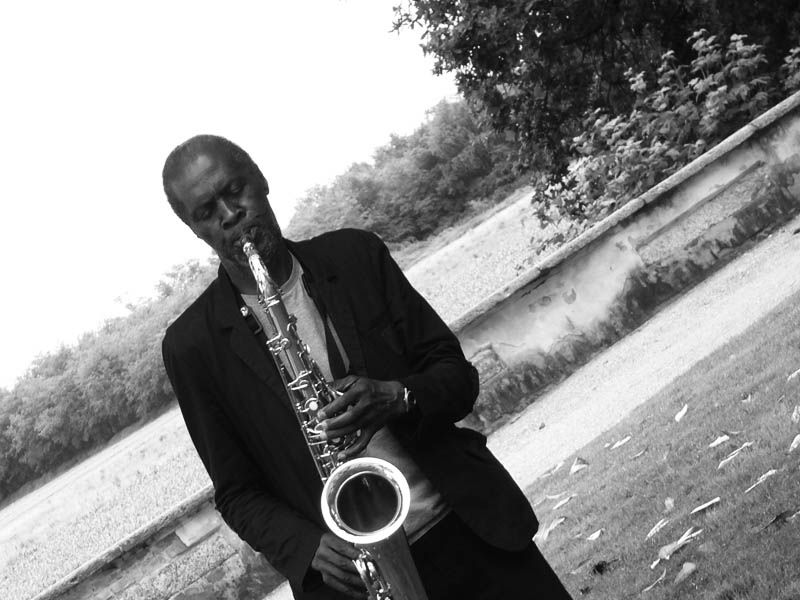
Despite the recent good albums I had the opportunity to listen to featuring trumpet player and composer Wadada Leo Smith, like Andrew Cyrille’s Lebroba (ECM, 2018), I have read contrasting opinions about his last efforts. As far as it seems he was not so brilliant in a series of concerts the musician held in the U.S.: according to the reviewer, he was too fond on personal clichés, and he was even juxtaposed to James Brandon Lewis, the young guy to take a look at since he was showing, at the contrary, an interesting evolution.
Anyway, the cynic in me concluded that the reviewer was possibly tired of listening to Smith’s music and was enthusiastic about a younger musician. After all, many people got bored after a period if they don’t find the right stimulus. Anyway, finally Wadada Leo Smith, one of the most important composers to sort out of the A.A.C.M., the Chicago’s Association for the Advancement of Creative Musicians, has released and album in duo with pianist, organist and newly minted NEA Jazz Master – NJM Fellowship is an honour given in the United States to particularly innovative musicians since 1982 – Amina Claudine Myers.
The album is inspired by New York Central Park’s environment, as the title of the album suggests, but there are also compositions dedicated to Albert Ayler and John Lennon. The First composition, Conservatory Garden, opens with Myers’ melancholic meditation. Every note resonates aptly thanks to the great work by former ECM producer Sung Chung, thanks to whom even Smith’s trumpet gain echoes and specific colors as it happens to the piano.
Conservatory Garden is possibly one of the best compositions in jazz I have heard since many years, and it’s worth the price of the album per se. You will listen to a composition of contemporary jazz but with that quality that is sometimes difficult to obtain, since it’s a matter of accents. While listening to it, I can really understand what Smith was telling me ten years ago about connecting the head and the heart.
The trumpeter is more keen on incorporating Miles Davis influence into his own language – in the past Smith claimed to have dreamed of Davis also, to stress the strong connection with him and his language of pauses, silences, and with his almost muezzin-like calls – but it’s the quality of the music itself and the interplay, where each musician is able to dive deep into the emotional motivation of the other, to make the difference.
Jacqueline Kennedy Onassis Reservoir sees Myers at a Hammond Organ, and since music is a matter of accents, we have a strong emotional shift from the first to this second composition, with melancholy leaving space to an almost subtle spooky feeling. Central Park at Sunset is even a more spacey and meditative, while the harmonic idea is verticalized becoming almost dolphian, even if Smith’s call maintains his spiritual qualities.
When Was is another step into an emotional journey, this time led by the piano only, that laps the territories of New Age – at least, of that part of contemporary music that laps New Age – without falling into it – thanks to some dissonances here and there, mostly in the second part of the composition - but this time I feel I can understand people who dislike this path into classicism. Luckily enough, the second part of the composition – almost a disharmonious fugue – is able to redeem the intentions of Myers.
The Harlem Meer is the most static of the compositions here involved: thanks to a trumpet that is soloing almost unaccompanied, we have the feeling of not being able to sort out of a strange dream. Albert Ayler, a Meditation in Light lives on the contrast between Smith and Myers music and the original evoked, so much thicker and denser. No one expects in the middle of an album like this a changing of the guards, anyway I will limit myself to observe that even Lacy and Waldron in some Black Saint/Soul Note albums were paying homage to Monk underestimating his angularity.
I don’t think Myers and Smith are asking for more attention from a wider audience, I suspect instead that the opportunities given to them by the recording process and output influenced their creativity bringing them to obscure part of the music they could give life to, making it all more monochromatic.
Finally, Imagine, a Mosaic for John Lennon is an even more rarefied, subtle composition. You can feel at a certain point how much Lennon’s efforts to contribute to a more just society are losing their breath, or maybe it’s just me, but up to a certain point I have the feeling the musicians are losing the point, closing at the right time before their music becomes too obvious.
Concluding, I would say that this album features some notable compositions, some of the most interesting in Smith’s and Myers’ careers, mixed with less well realised food for musical reflection. And while I’m meditating whether to look for a physical copy of the album, I’m happy I had the opportunity to introduce this album to my readers. After all, this is possibly not the right time for the perfect album or the complete masterpiece, but if you’re able to find a record with just some gems as in this case, I really believe you’re lucky enough.
When I saw this album on the shelves I was
curious and skeptical at the same time. Curious because in Eye
of I (Anti-, 2023), net of the recognizable influences (Ayler, Coltrane,
Ware, Brotzmann) that were available through Lewis’ elocution and that made me
classify him in the limb of the musicians that still need to find their own
distinct voice, the closing composition featuring The Messthetics, even if
reminding of Albert Ayler’s The Last Album (Impulse!, 1969), created interest
in me for future releases.
But now, with this disc in my hands, I was also
skeptical because I was fearing to listen to a derivative musician. The critics
that praised JBL in these last year weren’t mistaken, after all even Wayne
Shorter at the beginning of his career had a strong tie and connection with
Coltrane as a soloist, but being accustomed to listen to every sort of failed
attempt possible in order to give life to a proper improv or avant garde music
in the last ten years or so, I surely expect to be disappointed even by the
most emblazoned artists.
After some listenings I can say this is
partially the case. On a way, the album reminds the listener of the stylistical
changes of Henry Rollins’ Black Flag, prepared by the previous albums but come
to a well defined metal-free jazz shape with the EP Process of Weeding Out
(SST, 1985), a record that opened the doors for a plethora of bands that
incidentally prepared the audience for the future evolutions of post-rock and
stoner rock; on the other hand, more than a well defined bunch of compositions,
the album seems to be nothing more than a recorded jam session. Good stuff but
far from the intentionality we all exspect from some pieces of recorded music.
Even because the LP herein reviewed is without
title or, if you prefer, titled with the name of the band, as is to say ‘this
is our music’. Not that much for a self presentation. But let’s go with some
order. Messthetic is an experimental post punk trio comprised of the rhythm
section by the now on long breaks Fugazi (Joe Lally on bass and Brendan Canty
on drums) plus guitarist Anthony Pirog, a musician acclaimed at his appearance
on the scenes since his versatility and multifaceted style of playing, who
collaborated with the likes of Elliot Sharp and Henry Kaiser.
Arrived at their third album with this release,
Messthetics have been formed because both Lally and Canty wanted to keep on
experimenting with shapes and dynamics as they did since Fugazi’s Red Medicine
(Dischord, 1995). Their encounter with James Brandon Lewis came in occasion of
the last album of the latter Eye of I and this album can be considered as an
extention of the last track of that LP. The album opens with L’Orso where we
can listen to a thick but relaxed dialogue between guitar and saxophone and
some unison moments on a theme used by many jazz musicians as a device for
improvisations: all well done but nothing really new or exciting but the
feeling.
Emergence start showing Pirog virtuosity on
guitar and evolve in a mid tempo punk progression with Lewis on the stands that
suddenly turns into a ride where one can appreciate the tenorist efforts to
give life to a more precise style, confrontational and a little bit less
derivative, even if maybe this impression is a result of the sum of the parts.
That Thang start with another well abused riff that leave space to Pirog and
Lewis evolutions on guitar and tenor, this last more deconstructed, so to
speak, than the guitar parts.
Three Sisters starts as a ballad becoming a
nice progression, and since its use of dynamics is one of the most intriguing
pieces on the album even if it lacks some elements of surprises (that stop and
go moments, dub parts etc.) that were typical of some of the musicians’
mothership. Boatly is a composition that follows in the same furrow and gives
life to a nice, melancholic melody that suddenly turns into an anthem, while
The Time is The Place is another attemp to give life to a nice ground for Lewis
and Pirog respective soloing.
Railroad Tracks Home is yet another abused jazz
riff launched in order to give space to soloism. As far as personal tastes, I
find this alternation of rock and jazz stylistic features a little bit
predictable, and that this way the four musicians would produce an enormous
quantity of albums, that, as an example, is what King Gizzard and The Lizard
Wizard are doing right now. If you’re a great musician it is easy to jam and
produce something reasonable, but instantaneous composition is definitely
another matter.
Finally with Asthenia, a soft ballad, and
Fourth Wall, which have a more sustained rhythm, we’ve gone at the end of this
journey and we can say for sure this music is good enough to become something
we want to put on a plate just to relax while drinking something good, but not
enough good as a tool to learn something new about music developments. For
this, maybe James Brandon Lewis and/or the Messthetics will help us with their
future releases. For the moment we can take note about the fact that they are
able to enjoy their time playing but the spark is still far from shining.
I have to admit it: since I write only for
passion, without any income – I don’t even host banners on this blog, because I
hate when I try myself to read something through my laptop or telephone and all
those bright squares appear abruptly – it is easy to write what I want, being
also my own publisher. But tonight I want, while I listen to some good music
like Oliver Nelson’s The Blues and The Abstract Truth and Pharoah Sanders’
Thembi, to remove some pebbles from my shoe.
Fact is that Italy is a strange place if you
want to be a critic. In every musical genre, the mantra is always “you don’t
like it, you don’t talk about it”. This way, a critic is not a critic anymore.
The market is full of horrorful material and art places are, or better said were, full of horrorful
concerts. But let’s start with some order.
First of all: the ego affair. I was attending a
concert by pianist Vijay Iyer some years ago. I was part of the press staff,
since I was writing reviews for an Italian webzine called Mescalina.
That meant I had my own seat. In front of me an old guy, another critic, told
litterally everyone in the (deconsacrated) church near him: “Let’s see if
tonight I’ll discover a great pianist as I discovered Brad Melhdau many years
ago”. I didn’t knew who the guy was. But this is a first problem.
Mr. Iyer was still discovered. Blow Up, an Italian magazine that is
our version of The Wire – mine is
a conservative country so we always copy everything from foreign countries,
artistically speaking – still issued reviews of records and concerts by the New
York based pianist and composer. There was no need to re-discover him. What the
critic meant was possibly: Iyer need to be brought to the masses. I’ll do it.
What the critic unconsciously was saying was: Iyer need to be brough to my ear
because if I don’t know something, this something is previously unheard by
virtually all those who matter.
And this is the ego affair. There’s no such
thing as humility in the music world. Every critic – even me, for what it
worths – has his own idiosyncrasies – let’s talk about mine: I can’t stand
melodic jazz if played after bebop was born, with notable exceptions by singers
like Nina Simone, but as far as pianists they have to beat it or prepare it, at
the opposite if you’re a drummer and don’t own little percussions you’re out.
Obviously I listen to every styles of music, but
when it comes to jazz it has to be as much distorted. I’m joking about myself,
but if you don’t play free jazz in the present time you’re not adventurous
enough for me. And this is a limit, because I heard a beautiful Italian singer
dedicating a project, an entire CD, to David Sylvian few years ago and I didn’t
even write about it because the arrangements were too smooth to me. See what I
mean?
Now, let’s get over it. Every critic has his
own idiosyncrasies, that was the main point. But every critic – even me? I’m
asking myself right now and I don’t have so a proper answer – at least in my
own country believes his own tastes are the only tastes that matter. That’s why
it would be interesting to have other hands to strum that laptop keyboard for
this blog other than me. But I’m a maniac of control as everyone else in this
business. I think it as to do with the fear people would write with too much
indulgency.
Now, let’s move forward to the second point. In
this industry, you have to be controversial to be successful (and be paid).
This is often misinterpreted for having your own vision. Let’s make an example.
There was a guy, another critic, who now is one of the spearheads of a famous
Italian jazz magazine. Before, he had his own blog as me. Being older,
possessing a record shop and having more time than me to listen and read is a
good difference. Another are his own judgments over my world, that of free jazz
and improvised music in general.
Nothing against Coltrane or Ayler, but Dolphy
as an example was not completely at ease with composition during his career for
this guy – maybe I suggest because Dolphy died at an early age and always had
few money in his pockets: why aren’t we talking about all the musicians that
left the business to play litterally along the road like Giuseppi Logan or
Charles Gayle? And the reason was? The business in itself, not giving enough
money to the musicians and leaving the most part of it to the labels and their
managers.
But the judgment about Dolphy was motivated in
his dissertation about some recent re-releases of Chico Hamilton featuring the
multi-instrumentalist, so I have nothing basically against it but that if you
are a music critic you also need to be a little bit of an historian and an
sociologist. Just a little bit, because you cannot always know everything, but
it helps a lot. And what about Peter Brotzmann? This guy wrote in his blog many
years ago that the German reedist was a “paper mache figure”, with no further
explanation.
The guy also wrote and published a book full of
judgement more argued and debated, but this is the tenor, more or less.
Interestingly enough we had an email exchange in which I asked him why music
and jazz also worldwide was, with notable exceptions, deteriorating. During
those years the Turkish scene was exploding, and it was a good thing for the
experimental music scene in general, but at the same time I heard in my country
people whose attitude was really the one stigmatized by Mingus like, “fuck the
school, I’ll play free”.
I was invited in person to attend at concerts
where the musicians involved, releasing records also for their own little
label, were not even able to LISTEN the one the other and react properly. Same
in the world of contemporary music. So, I asked this now famous critic what
were his thoughts about it, and he wrote me something like he was too busy with
his own woman to think about this topics. I think he was saying I was loosing
my time trying to separate the sheep from the goats.
This leads me to the third point: there’s no
critic at all. An Italian musician once told to a friend of mine, that as me
wanted to write about music: if [name of a famous American saxophonist] plays
in a way you don’t like it, you can always write or say that he “played like it
was”. This, with the other advice other people gave to me about “you don’t like
it, you don’t talk about it”, it’s the end of my (unpaid) job.
It’s the end of the games, the end of the music
also. No critic, no aspiration to create interesting, fresh and new music to be
defined as such. No new music, welcome to the ego trip occupying the space
originally devoted to creativity. I started with the last point, but now the
cycle is complete I believe. Now. In Italy there is a horrible situation for
music. In the world is the same. The old masters are leaving us, the young ones
are interesting, sometimes very interesting – a couple names we discussed also
here: Mary
Halvorson, Patrick
Shiroishi, Lao
Dan – but none of them is renewing the palette bringing new colors to the
light, at least this is my opinion.
Maybe it is not the right time: politically
speaking this decade is worse than the 1980s. Economically and socially our
civilization is in pieces. It is not a surprise we have great talents, but no
innovators – I’d love to discuss this topic in the future with Anthony Braxton,
after rereading some of his books – the real problem is that no one wants to
talk about it. I lost an interview many years ago – my entry ticket to the
press in my country on paper – because of my attitude, my need to define what’s
good to me and what’s not, taking my own risks.
Because, if I look at what’s happening in my
country, this is the scenario. On one hand, you have trap music dominating the
hit parade, together or aside with Italian pop music. On the other hand, you have
virtually nothing. People who are in their 20 years or less are not even interested
in rock, alternative or experimental music. People of my generation, the Seventies, think
‘serious music’ is only Pink Floyd or Led Zeppelin – or The Cure, or Depeche
Mode – they don’t even know about Idles or Algiers, who are rock bands of the
present time.
As far as music played live, it is full of
40/50 years old people playing that kind of rock music for old boring people as
them. Young guys are interested mostly in people like Dark Polo Gang and their
values: money and success. There is no such a thing as a counterculture in my
country anymore. I truly believe this is also your future if you don’t pay
attention to it. From where do we want to start, right now?
Sadly passed away on August 5, 2023,
Tristan Honsinger was a hidden gem in the vast ocean of free improvisation.
Known mostly for his work with pianist Cecil Taylor and guitarist Derek Bailey,
but an accomplished musician on his own, Honsinger during his career
collaborated also with post punk bands such as The Pop Group and The Ex. This
remarkable folding of collaborations can give you also an idea of his style,
that span from nervous glissandos to melodic quotes traken from Albert Ayler or
classical music.
Born in 1949 in Burlingon, Vermont, Honsinger
had music lessions at a very early age, so he gave concerts on a weekly basis
with other members of his family since when he was 12. After he studied
classical cello first in Boston then in Montréal, where he became conscious and
interested in free improvisation. In 1974 Honsinger moved to Europe,
particularly in Amsterdam where he became a pivotal figure of Netherlands
improvised scene.
A musician that, according to the Dutch ‘Volkskrant’
journalist Erik Van de Berg “hasn’t lost his childhood fantasy entirely”,
Tristan Honsinger can be taken as a representative figure for what European
Improv scene is: for such musicians in fact ‘playing’ means not only expressing
yourself through music, but also to take risks. While many would cite irony as
a main topic for such improvisors, more than that their attitude is that of a
child curious about what sound he can obtain from his instrument.
Spanning through his discography, a must have are
his records with pianist Cecil Taylor, but there are also interesting
collabortions with conductor Butch Morris, records for solo cello and duos with
Derek Bailey and saxophonist Sean Bergin. The more adventurous listeners can
try and find a copy, as a mere example, of his record with Steve Beresford,
David Toop and Toshinori Kondo for Double Indemnity issued in 2001.
On June 22, 2023 multi reedist, composer,
improviser and fluxus alumni Peter Brotzmann has sadly passed away. This
article is our way, after a long
interview released many years ago, to remember him. Peter Brotzmann during
the 1970 was the true face of European avant garde jazz, and along with his
partner and mutual friend Evan Parker one of the pivotal figures of improvised
music.
A close friend of visual artist Nam June Paik
and others pertaining to the Fluxus movement, Brotzmann tried to incorporate
elements of this iconoclastic idea into his own playing. Brotzmann style at
saxophones is assertive, violent, abrasive and a little bit ironic. In the following
years, after being cherished by Don Cherry and other American avant-garde
artists more than by European critics, he started playing with musicians coming
from the other side of the ocean like William Parker, Ronald Shannon Jackson
and Bill Laswell.
This is a quick introduction to his
discography. The first album you have to listen is Machine Gun (FMP, 1968).
Here Brotzmann is leading an octet featuring Willem Breuker, Evan Parker, Fred
Van Hove, Peter Kowald and Han Benning among the others. The music is
surprisingly violent, with at the beginning the horns section imitating the
sound of machine guns, in an attempt to give life to ananti militarist concept. But the music is
texturally rich, with the various musicians giving life to a multi structured
creature.
You can find the same assertiveness on
subsequent records like Nipples (FMP, 1969) and Fuck The Boere (FMP 1970), an
album dedicated to the South African musician Johnny Dyani who died in the same
years. An album that is worh of attention and of deep listenings, a true
testimony of creativity and fantasy, is Schwarzwaldfahrt (FMP 1977), in which
Brotzmann and mutual friend Han Bennink recorded a live set of free music into
a forest, with Bennink beating logs and other natural elements with his sticks
and Brotzmann utilising his many saxophones so to create a site specific music
inspired by nature.
During the 1980, a period not favorable for
experimentations, Brotzmann gave life to the quartet Last Exit, with U.S.
musicians such as Sonny Sharrock, Ronald Shannon Jackson and Bill Laswell. The
music here is even more heavy and dense, and in a way it anticipates what John
Zorn at the end of the decade will create with his band Naked City. Now finally
accepted as the uncompromising musician he is, Peter Brotzmann can finally
manage to give life to various line up and various musical creations.
During the 1990s, his most important
combo is the Die Like a Dog Quartet, an hommage to Albert Ayler that featured
again U.S. musicians like William Parker, Hamid Drake and japanese trumpet
player Toshinori Kondo. The quartet issued four albums of pure existential
poetry, in which reflecting on life and death through notes is part of a
project that is one of a kind. While in effect many musicians like Marc Ribot
tried to hommage Ayler playing his own music, Brotzmann quartet gave life to
new material instead of reproposing old tunes.
A second life, if necessary, was given to
Brotzmann music during the end of the 1990s and the beginning of the new
century by the Peter Brotzmann Tentet, featuring musicians such as Ken
Vandermark, Jeb Bishop, Joe McPhee, Paal Nilssen-Love and Fred Lonberg-Holm
among the others. The tentet and his various combinations in duos, trios, etc.
gave life to a live adventure that brought Brotzmann all around the world
performing fresh and harsh music, making the old master known to younger
generations of musicians and fans.
As every master musician, Brotzmann is
particularly fond in the art of soloing, even if that part of his own work is
not completely above the banner of his most recognised art. Two albums in
particular can be advised to the listeners issued in recent years: No Nothing
(FMP 1991) where Brotmann imagines a different concept for each of his
instrument like e-flat clarinet, alto sax, bass sax, tenor, tarogato, and I
Surrender Dear (Trost 2019) where he reinvents classics like Lover Come Back to
Me or Con Alma at tenor saxophone.
Having toured extensively during the last
years, Brotzmann has played with an enormous variety of musicians, among which
Keiji Haino and many others coming from all over the world: from the East to
the West, many artists payed a tribute to the complex art of Peter Brotzmann
playing with him. Impossible to imitate, difficult to be inspired by, Brotmann
was one of a kind for technique and vision. Possibly his leaving is the sign of
the end of an era.
As Marc Ribot, author of a project around
Albert Ayler music titled Spiritual Unity in 2005 with fellows Chad Taylor on
drums, Roy Campbell on trumpet and former Ayler’s bass player Henry Grimes,
said in an old interview for an online jazz magazine, listening to Ayler’s
music on record is like to hear a strange human sacrifice happening in the room
next to yours.
Obviously he was referring to some of his
favorite Ayler records like Spiritual Unity, recorded in 1964 by a trio
featuring Ayler on tenor saxophone, Gary Peacock on bass and Sunny Murray on
drums, who has this haunted quality: in particular the drums are dusty enough
to seem coming from another world, the world of spirits, and the saxophone honks
and squeals during the solos in a way that gives the listener this idea of
suffering, at less until you don’t become confident with this sound and idea of
music.
Last decades were great in order to know better
Ayler’s music: ESP rereleased all of his back catalogue, including many of
Albert Ayler masterpieces like the one sided Bells, in 2004 a 10 discs boxset
titled Holy Ghost was released by Revenant, comprising music not published
until that year coming from 1962-1970, amongst which the incredible performance
held at the John Coltrane funeral march.
In addition to these, saxophonist Peter
Brotzmann reissued in another boxset all the recordings by his Die Like a Dog
Quartet in 2007, an hommage to the incredible life and death of Ayler narrated
musically by Brotz with Toshinori Kondo on trumpet, William Parker on bass and
Hamid Drake on drums. Something delightful for all the Ayler fans scattered
into the world. Unluckily all this material is limited editions, and in 2022
they’re quite unavailable for the masses.
Imagine my joy when I found out this 4CD boxset
titled Revelations was issued this year by the label Elemental: I had to grab a
copy myself, and I did. All around the web but also on paper you’ll find a
division of Ayler career in two parts: the early years and the Impulse!,
commercial years of rock fusion. Nothing more false. To tell the truth, there
are three periods in Ayler music: the first formative years, full of changes in
his style, a period comprised between the release of Spiritual Unity and the
first live albums on Impulse!, where Ayler’s music passed from that haunted
quality we talked about to a more innodic shape, and then another third period
in which he tried new music as he always did.
In this last period, Ayler tried to reimmerse
himself in his first rhythm and blues roots, mixing them with electric guitars
but also with pipes, Mary Mariah – his wife – voice, and different musicians
behind them. In the concerts you’ll find in this box recorded during the Nuits
de la Fondation Maeght, featuring for the first time ALL the music played by
the quartet the first night and the quintet enlarged thanks to the presence of
pianist Call Cobbs, old pioneer of Ayler’s first days, it is as if Ayler was
trying to summarise all his different periods in order to gain momentum for a
new adventure.
Obviously all the criticism for Mary Parker
appereances on records, and the guitars completely absent from these live
performances, fade away in front of such compact, spiritual driven, epiphanic
material. From the beginning of Music is The Healing Force of the Universe,
taken from the Impulse! same-titled album, the sacred fire of the performance
is clear, as clear is the direction of music, that of the ‘classic’, which
means ‘innovative’, Ayler free music. But this four CDs are full of surprises:
Mary Maria plays soprano saxophone, and she’s a not completely refined player
as his husband, but anyway able to impress.
On the other hand the rhythm section,
comprising Steve Tintweiss on bass and Allen Blairman on drums, is a synthesys
of every rhythm section Ayler had in the past, suitable for the present shape
of Ayler’s music. You’ll hear also Albert Ayler imitating the sound of his sax
with the voice, in a strange scat that anticipates more elaborated forms of
avant garde singing in the next decades, and classic tunes as Spirits Rejoice
(the famous ‘Marseilleise’), Spirits, Ghosts, and the more recents Holy Family,
Zion Hill and Love Cry in new suits.
Differently from other boxes issued in these
last years, as Eric Dolphy’s Musical Prophet 3 CD boxset or the flamboyant 4 CD
boxset Sun Ra – Egypt 1971, this box is a little bit more expensive. But the
price worth not only because it was remastered completely from the original
sources for the first time, but also because of a beautiful booklet of 100
pages full of essays, notes, photos, and testimonies by peers, mostly modern,
like John Zorn and Bill Laswell.
Ayler was a true innovator, and also, maybe, a
tormented soul, we don’t know clearly even after many years, but his music is
here for us to stay after all these decades as something talking to our souls
and ears, and it is full of ideas for younger players. Those who will listen to
it carefully during time will be captured for life.
Francis Bacon, Three Studies of the Male Back, 1970
I started Gilles Deleuze's "The Logic of Sensation" this winter, and when I read the pages related to the concept of "histeresis", and its application to modern painting - the blurring of the boundaries between object and subject, the use of color as rhythmic pattern - by the French philosopher, I found out that what he put on the table was in fact embracing many of the artistic tides developed since the second half of the 20th century. Deleuze's book is about Francis Bacon's painting, but, as many of the philosophers writings, it tries to be inclusive and to track a sort of 'minor' history of the most vital artistic statements of the time, and back. But, far from what Gilles Deleuze embodies in his text - Francis Bacon, Vincent Van Gogh, Eadweard Muybridge, Diego Velasquez, Paul Cézanne, as long as Samuel Beckett, Franz Kafka and Marcel Proust literary masterpieces -, I was thinking first and foremost about Antonin Artaud - on which Deleuze himsepf came back in many of his essays, from The Logic of Sense to A Thousand Plateaus - and performance arts, from Vito Acconci to Marina Abramovic. And, obviously, to music.
I was listening to Roscoe Mitchell's No Side Effect (RogueArt, 2006) in those days. So in a certain way improvised music (Albert Ayler, the AACM) was implied in surrounding the impressions Deleuze's book gave me, but, in my effort to articulate a more extended analysis, I have to imply also Demetrio Stratos' and Sainkho Namtchylak's studies on voice, that are related to some techniques many post-bop horn players developed, starting with John Coltrane. Maybe the proper field for this study would probably be European contemporary music, with Iannis Xenakis and Karlheinz Stockhausen as examples of what was then called 'post-serialism', and the so-called 'Industrial music' - this definition in Europe doesn't include music related to heavy metal, but forms of music developed first as accompaniment for performances, and then risen to a proper authonomy with Throbbing Gristle, Einsturzende Neubauten and Maurizio Bianchi -, and the Sound Art, as a matter of how the sound can influence the perception of the space.
In this article I want to give some tools that can be useful for a first approach with a discussion on how the French philosopher's essay fits with music, and to what extent, skimming through genres and styles. Deleuze was very influent in the 1960s here in Europe and then in South America, where he still is. David Toop in his Ocean of Sound talks diffusely about Deleuze's concept of 'rhizome' - a root without a proper original branch, metaphor for a way of thinking without relating reality to a unique and univocal meaning - as a strategy to reach a 'nomadic' way - a way not based on given, i.e. 'sedentary', structure of language, of signifying - to approach creation; that's what Sun Ra's and other jazzmen were doing: issuing their own records on their own labels, and so avoiding artistic compromises, and then giving some of their artefacts to some major or independent labels. That's what the avant-garde pianist did, as an example, with Space is the place, issued on Impulse!, or with Nuclear War, published on Mark Stewart's On-U Sound.
Francis Bacon Study for the Head of George Dyer
Hysteresis, so. It's difficult to undesrtand it correctly if you are not aware of some cornerstones of the structuralism. In particular it would be interesting to focus on Jacques Lacan's seminars about psychoanalisis and the concept of 'hysteria', that he, as structuralist, considers as the refusal to apply the language of Power to the body, as the proper feeling of the hysteric subject. And this, because power refuses to give desire his proper place in the world of language and in the word of the Law. As far as desire, for Lacan, "desire is neither the appetite for satisfaction nor the demand for love, but the difference that results from the subtraction of the first from the second." Lacan adds that "desire begins to take shape in the margin in which demand becomes separated from need." So desire can never be satisfied, as Slavoj Žižek says: "desire's raison d'être is not to realize its goal, to find full satisfaction, but to reproduce itself as desire."
A good part of the Deleuze's thinking is based on the opposition between power and desire. The concept of power is taken from Hegel and seen as something - the dialectics - that comes from, and produces, dissociation - thesis versus antithesis. "Petrolio", a novel by Pier Paolo Pasolini, or his Salò movie, are good literary translations of that concept. Desire is all that remains when the structures of the speech as a form of power on reality - the presumption to give order to reality with words - collapse. Again, Pasolini's 'Teorema' is a good picture of that idea. At the center of the paintings of Bacon there is a work of removal, an ethic work that leads precisely to abandon power for desire. Bacon take away the figure, the shape and the filling is blurring, so there are no more specified subjects - man and animal, subject and object, figure and environment, and so on.
And again, movement in Bacon is always double, systolic and diastolic at the same time. An abject athleticism - from latin 'ab-jectus', something that remains beyond the sub-jectus, which is the subject - leading from the figurative pattern that imprisons the figure into being only in this movement - the sink, the mirror - and filled to the figure - the body as Plexus / spasm, hysterical scene: escape through any body prostheses: syringes, umbrellas, mouth / scream ... -. Extraction and isolation, as opposed to the intelligible narrative relations of classical figurativeness. The butchered meat, the zone of indiscernibility between man and animal. The bones will rise from the flesh, as the flesh descended from the bones. Acrobatics of the flesh, an extension of athletics in the body. Face, head, cry escapes the body through the mouth, like blood from a severed artery. Spiritual movement.
Place created by those forms of art is similar to the anthropologist Victor Turner concept of 'liminarity' in his 'Rite of passage', and a good picture of it can be considered the way a Tibetan singer uses his throat in order to produce a double sound, positioning his tounge and glottis as if he is passing from 'l' letter to 'm' letter. This is a 'middle' position, but one that produces a double sound. Hysteresis, so, is the 'rhythmic' eye. The eye becomes ear: it feels time, as does the ear when you listen to music. And so becomes 'schizophrenic', says Deleuze, but not in the usual sense of dissociation. Schizophrenia as music is, because music disembodied bodies, the place (not the concept) of vanishing lines that cross the bodies themselves, but that are consistent elsewhere, hysterized through the introduction of color. How can we not recognize in that description the timbre, old fetish of improvisers, but also the use of a certain layering of sound even in analog and digital electronics, or in some contemporary composers, as in Karlheinz Stockhausen or Iannis Xenakis? How about electronic music, be it Miles Davis electrified trumpet, or the first contemporary composers in producing music through ring modulators?
The body draws on its new organs, like Antonin Artaud had predicted in 'Pour en finir avec le jujement de dieu'. It's a metaphor for multiculturalism, in the sense of the crossing of two different cultures, that usually produces something completely new: the 'african-american' music isn't a mere adding of two cultural forms of art: it is a totally new music. The 'hysterized eye' ceases to perceive the figures arranged in space according to a scan or narrative perspective, and through the articulation of three elements - material structure / set position / area and contour as the unfocused limit of both - creates a structure of rhythm / feeling. The body is thus the zone of indiscernibility between subject and object, between sentient and heard. Pure affection. The feeling acts as an agent deformating the body, and creates a gap in which it is organized through a sequence, a spasmic passage from a level to the other.
So let's go back to music, to the rhythm given through the use of color. It's something similar to the dyplophonies used in Tibetan singing, or to the resonances of certain Arab, Middle or Eastern instruments - qanun, sitar -. But the same is with the way a musician like Roscoe Mitchell sometimes uses triplophonies on his horns. Same with Coltrane and Pharoah Sanders, their use of tritones: they aren't a mere addition of a sound to another, but a new form of vibration. And the same is with the bass lines Henry Grimes give shape as a matter of texturizing different colors, different layers of sound.
Surely, if we think about avant garde jazz, its roots aren't in Western philosophy, but in a practice that is more confident with other concepts, like sound as vibration, as an example. Quoting Sufism and his mysticism can be a better idea. But since the 19th Century European thinkers - e.g. Schopenhauer or Nietzsche were both enthousiasts readers of the Bhagavad Gita- were looking at the Eastern World as a new model, less related to the division between reason - the self-consciousness as the result of the ego seeing himself - and the irrational - all that can't be explained with scientific measures. Psychology and anthropology - Carl G. Jung ideas on Symbols and Collective Unconscious, as Victor Turner idea of Experience - are more related to an Olistic approach to the human mind than Freud's idea of the Ego and Hegel's concept of dialectics. A more fluid approach to things, and a reflection of that knowledge parameters change can be seen in Antonin Artaud's 'The theater and its double', or in Jerzy Grotowski's Toward a poor theater; the same is with Francis Bacon and, to some extent, Jackson Pollock's paintings, and music after the middle of the last century.
This year's edition of Novara Jazz will stand up for a couple of remarkable highlights: Ebo Taylor, who played in Piazza Duomo on May 27 with his Afrobeat hot-flavored call-up, and a couple of exhibitions, in the same day, by Charles Gayle. New York based saxophone and piano player is truly achieving Coltrane's and Ayler's legacy, both on a stylistic and personal level. Gayle is part of a post-bop world that, even before the so-called new thing started harassing the scene as a demanding music-to-listen-to right in the middle of the '60s, waving on his flags statements like Spiritual Unity, wasn't completely feeling at ease with tricky chord changes and bebop jumping out of diminished 7th, even if that was, at the time, the most fashionable way to express yourself.
In fact, while jazzmen, after Parker and Gillespie more orthodox followers, tried to warm and cool music with always excellent but as different results, as the likes of Miles Davis, George Russell, Oliver Nelson, there was an unprecedented and parallel world of, mostly, unsung heroes, that were trying to go back to their gospel and church roots. Charles Gayle, as his more succesfull, posthumously speaking, fellow Albert Ayler, drew heavily on chants and prayers. Picking up a record like Forgiveness (Not Two, 2008), and skimming through the titles, like 'Living Waters', 'Glory, Glory, Glory', 'Forgiveness', makes widely noticeable their being coherently in line with 'The Bells', 'Holy, Holy, Holy', 'Initiation'.
Surprisingly enough, Gayle's voice on alto is very related to Ayler's. But while the latter's phrasing was shakey, nervous, confrontational, the former's more gentle, chubby, and in some way more devoted to the way another tenor master, John Coltrane, was usually binding together his statements, at least in a period of his career: starting a line, developing, then coming back to a previous point and going ahead again from that. More spacey, less torrential. Check out his version of 'Giant Steps' to feel what coming from a demanding development of a coherent tought back to his straight essence would mean.
Charles Gayle, Conservatorio Cantelli, Novara, June 2, 2011
Being an open space the ideal venue for a solo alto saxophone or not, Gayle's set was warm, confidential, friendly. The night, in Novara's Academy of Music, a gorgeously fixed old Steinway embellished with full and rich resonances his curling, striding, deep, dissonant, but utterly melodic playing. Whereas he so often layered the bottom to the peak, using even his full arm on the keyboard, or chuckling gently his fingers, the lightness of his touch in both those gestures and in all the possible ranges in between remains a constant, and maybe Gayle's proper, excited but jaunty and bright signature.
Clusters and melodies are both interspersed the one with the other, bulding up a language that openly moves from jazz tradition but that evolves in apersonal statement in which what can seems apparently fuzzy is, in fact, a grooving, hazy network of cross-references, from Thelonious Monk to Art Tatum, from James P. Johnson to Cecil Taylor. Charles Gayle lived for many years following his highly personal options, and as a result he is truly suitable for speaking not only for himself but for a rich and full tradition of inside track shapers.
Just read the first time about this record on JazzMagazine (a beautiful issue, with a long, relaxed interview with Cecil Taylor) a year and a half ago. It was a tiepid Sunday morning, Hamid Drake and his Bindu Project would have enlightened the end of the week with a gorgeous concert in Milano ... reggaeology, baby, that's the matter!
Didn't seek for that record, because of many others, but last Saturday finally I got it. I'd really put my hand on fire for those guys, since Roy Campbell played on Spiritual Unity group, with Marc Ribot, Henry Grimes and Chad Taylor, and, finally, because Joe McPhee played with Don Ayler, Albert's brother and you can really hear the Holy Ghost coming out of his mouth right into his tenor saxophone. Wiliam Parker is on bass (yet involved in Peter Broetzmann's tribute to Ayler, Die Like A Dog). Drummer is Warren Smith, member of Max Roach's M'Boom, contributor to Tony William's Lifetime, Julius Hemphill, Muhal Richard Abrams and many others.
Music is the Healing Force of the Universe, wrote Albert Ayler. The lyrics are played without sounds, since Ayler was an inspired poet and his latest records, often underrated because he was bringing his vision back to popular roots (r'n'b, funky) so that lots of people at the time wasn't acknowledging him and his pals as true innovators. But is' a matter of fact that records like New Grass, though sinked into a less improvisational environment, are as good and genuine as their inspired author.
But Ayler music is related to Truth is Marching In, so in this record there are a couple of pieces directly related to his ethics: Mantu, a tribute to Miriam Makeba (flamboiantly relaxed, groovy and positive), and Obama's Victory Shout, that fades directly into one of Ayler's anthems. Anthemic Prophet John, written by Ayler brother and dedicated to John Coltrane (the Father of free spirit) is powerful as the version I heard on Revenant's Holy Ghost box, and then back again to Universal Indians, another Albert's last period tune.
Recorded during 2008's Banlieues Bleues Festival, this CD is accompanied by a beautiful booklet with photos of the event and an interview with the musicians, conducted by Jazz Sociality class students taught by Alexandre Pierrepont at Science-Po (Paris), available in its entirety at http://www.pointofdeparture.org/PoD24/PoD24ParisianThoroughfare.html
Personnel: Joe McPhee-tenor sax, pocket trumpet, voice; Roy Campbell-trumpet, pocket trumpet, bamboo flute, recorder, voice; William Parker-bass, voice; Warren Smith-voice, percussion, drums.
Track Listing: 1. Music Is The Healing Force Fo The Universe 6:31; 2. Muntu 15:19; 3. Obama Victory Shoutout 13:50; 4. DC 16:51; 5. Prophet John 15:05; 6. Universal Indians 6:40