Sunday, July 10, 2022

Master Musicians of Jajouka led by Bachir Attar “Dancing Under The Moon” (Glitterbeat, 2022)

Sufi poetry and music has a noble and long tradition. Sufism is the exstatic and mystic faction of Islam. Few decades ago, Syrian poet Adonis wrote an intriguing essay titled On Sufism and Surrealsim where he compared the twos, assuming that the poems of Rumi and those of Bréton have many things in common. It is not my intention to summarize the essay here, but I want only you to be conscious about the fact that letting our inner self speak is not easy but important, since our rational part is only a small percentage of our abilities.

Having composed a little surrealistic poems myself and for myself, I can deeply understand that, even if our science is nowadays criticizing the idea of a ‘subconscious’ that psychoanalisis posed as angular rock of its exploration of the mind, there’s something hidden into ourselves that social life and rationality try sometimes to hide from our conscience. This hidden part is strictly related to our desires. I remember, as an example, that sensation of hunger and sexual desire I felt before I ended my first painting (horrible as it was, being my first attempt, but this is not the point). Gentle feelinga, not related to the phenomenon of craving as it happens to you when smoking a joint.

Obviously Sufi music is not related to desire, but if you read Rumi poems, being near to God is quite often comparted to be near a beautiful lover, or to being drunk from love. Sufi music, instead, is varied and you can find different kind of music with different kind of intent. Sufi music from Morocco, called Jbala, is a particular style whose goal is to induce into the listener, with performances during many days, a state of trance, in particular related to the loss of the sense of time.

The psychedelic qualities of the music of the Sufi from Joujouka hit for sure the first journalists that from the 1950s on started to testify their existance. At the same time, the following decade, the same qualities attracted both Brian Jones from The Rolling Stones and Beat poets like Paul Bowles, William S. Burrooughs and Bryon Gysin. After being introduced to the world by Jones himself who issued the album Brian Jones Presents the Pipes of Pan at Joujouka (1971) and their following collavoration with Ornette Coleman for the album Dancing In Your Head (1977), the group of musicians started to being recognized all around the world.

In a way anticipating the so called ‘world music’ along with other pioneers discovered in the Flower Power era as Ravi Shankar, the Master Musicians of Joujouka recorded many record and toured throughout the entire world before splitting. In fact, in the early 1990s two groups were nowadays residing in the small village of Joujouka: the ‘original’ Master Musicians of Joujouka and the Master Musicians of Jajouka led by Bachir Attar, the son of the leader of the band during the 1960. Obviously it is harsh to understand what is the original or the best band from the twos.

In fact, both contaminated themselves with the world of contemporary music: the “Joujouka” masters played with Jarvis Cocker and The Orb, while the “Jajouka” were produced at least in one of their albums by Bill Laswell. So in this post we’re gonna describe last album issued, this year, by the second combo, titled “Dancing Under The Moon”. Produced by Jacopo Andreini, drummer of the post punk Italian-French band L’Enfance Rouge (one of my favourite groups ever apart from jazz music), and featuring a booklet full of photos from the sessions and liner notes by the famous journalist Stephen Davis, author of books about Led Zeppelin and Jim Morrison, the album foresee sessions recorded on November 2019.

The band is comprised of seven members playing different instruments as ghaita (a double-reed flute), guinbri (a large plucked half-spike lute), lira (a crossbar lute) , violin, and different types of percussions. There are pieces of music where the percussions are widely spreaded as in Dancing In Your Mind, or where a sweet flute and the lutes introduce a crescendo as in The Bird Prays For Allah, and other where singing is on the foreground as in Yes, Yes, Be Patient My Heart. As I can understand through the titles of the pieces, the themes are the classic sufi themes: the love of God, the chant of love from nature, being ‘intoxicated’ or exalted  by the love of God himself.

Don’t be surprised to read about such music in a blog related to jazz and improvised music. On one hand, these musicians played with a jazz master like Ornette Coleman in one of his most beautiful records, on the other hand this music deserves to be recognized since I truly believe that music can root all human beings into another dimension from where we can go back with new tools and skills in order to improve our world. You don’t need to believe in God for that, it is enough to look at the climate change and the war to get how much we need a new way of thinking. 


Blue Notes “For Mongezi” (Ogun 2008, reissued in 2022)

Mongezi Feza was one of the best trumpet player to come out of South Africa. Born in Queenstown in 1945, he started studying his instrument at the age of 8. In 1962 he joined pianist Chris McGregor, altoist Dudu Pukwana, bassist Johnny Dyani and drummer Louis Moholo-Moholo in the Blue Notes. Their first concerts, as testified by my latest review, were an hommage to the flamboyancy of Charlie Parker and bebop and the hipness of Thelonious Monk, to whom many themes of their original fist compositions are paying openly hommage.

The Blue Notes played in different clubs and venues, universities comprised, even if with great difficulties and always clandestinely, being a racially mixed band. After 1964 and their appearance at the Antibes Festival, they started to reside first in Europe and then in the UK, where they had a huge influence both on the scene of improvised music and of rock music. After playing together in a large ensemble called The Brotherhood of Breath, Feza eventually died on December 14, 1975.

This album, For Mongezi, originally issued only in 2008 and now reissued this year, comprises the music originally played at Mongezi’s memorial service. The original music, here in this reissue completely restored, was longer than 2 hours. It is useless to describe point by point what this music sounds like. It is obviously vital, forceful, dense, intense, of impact. Differently from the last record reviewed, this album is not devoted to bebop or post bop music. It is, indeed, a session of music that is keen on free improvisation and roots music, as Coltrane’s Kulu Sé Mama, if we want to find out a far away relative.

On many occasions we can hear Dyani great work on bass, pinched and arcoed, accompanied by drums and small percussions, McGregor ability to play atonally, influences coming from the US more than from UK anyway (The Blue Notes improvisations are never “non idiomatic”) and also from South African folklore, mixed with Pukwana and Moholo-Moholo invocations. Pukwana style on alto seems to have been developed from the original Charlie Parker influence to that of the late great Jimmy Lyons, with that oblique melancholy and bitterness who abruptly develop itself into a cascade of notes without being a clone.

But this record is important, as it is the memorial service for John Coltarne where Albert Ayler played captured in the monumental box set Holy Ghost, because we can feel how much different for African-American culture a departure is from European culture. It is not a matter of believing in the spirits or in a different life, or maybe is, but mostly is a difference related to agency. I remember you, so I’m here playing for you. I’m not only feeling emotions, but I’m sharing those emotions with the world, so maybe, I argue as a critic and as a listener, you are still alive with us throughout our playing, as a source of  inspiration.

Music to be listened to carefully, music filled with love and compassion, music that gives you at once that feeling of intensity and those nuances of depth into the souls of the players involved. If, as someone said to me, the Live in South Africa from 1964 showed us some musicians in love with jazz and willing to recreate that music but not completely mature, this For Mongezi instead leavea us listening the music of four complete and original musicians.

One can hear how important this music was for European improvisers, giving them that feeling of being rooted somewhere even if maybe only technically. Possibly Evan Parker, Alan Skidmore and Mike Osborne were compelled to develop their style incorporating that ritualistic element you can hear through this record. I wonder, as an example, if the binaural sound of Parker, that is his ‘playing through the void’ as he asserted during one concert I attended in London, was influenced somehow by Pukwana and friends’ way of creating music.

Obviously every music need an element of grounding, every form of art. The Blue Notes developed an intense link with ancestor’s rituals, stripped from their original believing – or maybe not? – but dedited to create a sound and a meaning that is modern and ancient at the same time. After all, music is still a ritual nowadays. For many people is a way to meet their idols and the community of listeners to have some fun, for others is a way to beign recognized by and recognize a community, for others again is a way to develop human skills as compassion and brotherhood, but always the spirit of the music is trying to uplift people outside of the everyday problems giving you the opportunity to enter into another dimension so that you can take it and bring it into the realm of reality. To make it better.


Friday, July 8, 2022

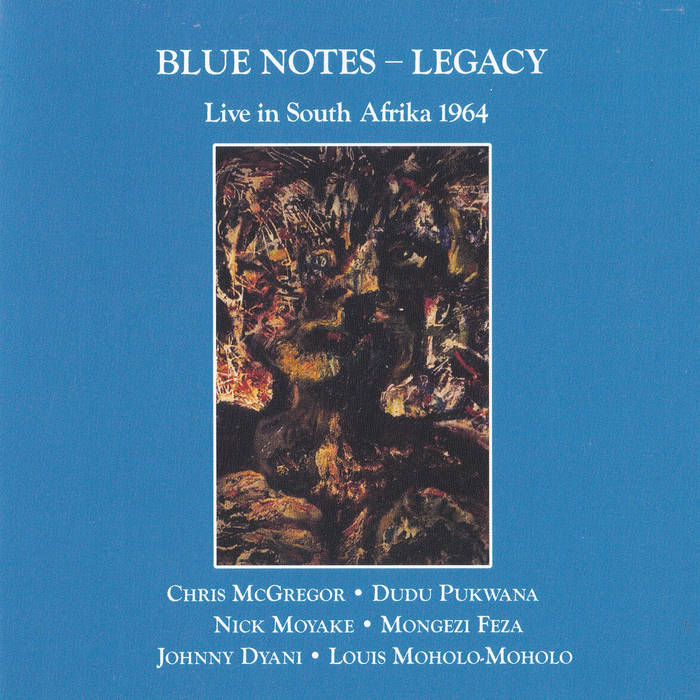
The Blue Notes “Legacy Live in South Africa 1964” (Ogun 1995, reissued in 2022)

If you would listen to fresh improvised or experimental music in 2020 or so, outside of Europe or the United States, you have to go to Mexico. If you would listen to something similar and at the same coordinates, but in 2010, you had to go to Turkey. There, in particular, you would be able to find musicians striving for their freedom of expression issuing new records and setting new collaborations, as the one with european genius saxophonist Peter Brotzmann and US incredible bandleader and multireedist Marshall Allen.

But what if you were searching for a new, exciting sound during the 1960s? Obviosly the answer would be: go to South Africa. There, despite of the apartheid, a bunch of simply brilliant and original musicians, mostly exhibiting through Universities or small clubs, were trying to overcome the barriers dividing people from people using music as a tool, as a device, as a peaceful weapon.

Why are you reading on this blog about this bunch of courageous musicians? Because label Ogun is now reissuing Blue Notes catalogue, and luckily enough last saturday, hanging around into some small record shops, I found out some copies of these records. In this review I will tell you about the live album Legacy – Live in South Afrika 1964, originally released only in 1995 because printing records of mixed bands during their lifetime wasn’t easy in the land of Nelson Mandela for many decades.

Legacy is a record that features the music of a sextet. The performers involved are pianist Chris McGregor, altoist Dudu Pukwana, tenorist Nick Moyake, trumpeter Mongezi Feza, bassist Johnny Dyani and drummer Louis Moholo-Moholo. This line up of The Blue Notes recorded in Durban this session of live music that, according to the first two pieces, Now and Coming Home, is more keen on Thelonious Monk as far as themes and development.

Life was not easy for a racially mixed band in the 1960s in South Africa, and so they moved quickly to London where their influence on both improvised scene and the so-called Canterbury Style was highly praised during the decades, giving the musicians involved the opportunity to become keener on a less non idiomatic and more direct way of expressing themselves through music, or the possibility to expand their palette with one foot into jazz and not only into rock style.

McGregor and his pals gave life to the Brotherhood of Breath when in the UK, but this record from the ‘segregation era’ is vivid, pulsating and interesting. If the first and second tracks are monkian as we have written here above, with I Cover The Waterfront they give life to an intense cover of a classic from the jazz repertoire; in listening to it one wonders what if they would have played it at the Juan-Les-Pins festival the same year. I strongly believed a black panther like Archie Shepp would have approved.

Two for Sandi is an original by Dudu Pukwana reminiscent of the bebop or post bop era, where he gives life to an incendiary performance along with his friends reedists, starting from Feza, after a quick introduction and a tutti-exposed theme. After some rest, with the mid tempos of McGregors’ Vortex Special, where the solos of alto (Pukwana is simply telling a story with all its nuances in there) and trumpet (Feza expresses himself through different colors and shapes here), while the tenor of Moyake plays far beyond the limits of a human voice as this particular saxophone is compared, there’s time for a little hommage to Miles Davis and So What thanks to the piano and reeds, before going back to the main theme of the original composition.

B My Dear and Dorkey House are a couple of themes from Pukwana. The first is a ballad still indebted to Monk, as the title itself can suggest, with an evocative tutti from the three horns which gets a round of applause by the audience, followed by a beautiful piano solo, while the last piece is another hommage to bebop, with flamboyant solos by Pukwana himself, Feza and Moyake. Far from being pure improvised music, this album shows a love for different traditions in the jazz area but with a cooperative more than a conflicting attitude.

In fact, the musicians are proud to expose their style and sound but without fighting for being recognized as the best performer over the others: we can feel yet that cooperative mood that from the following decade will hopefully become the norm in the jazz world. But the importance of this record is that of a hystorical testimony for all those who are interested in how jazz music had an impact on different lands and traditions, and how these new expressions modified the process in the mainstream communities of the free jazz and avant garde era. 


Saturday, June 4, 2022

Charles Mingus "Charles Mingus Presents Charles Mingus" (Candid, 1961 reissued in 2022)

The business related to reissues, both on CD and vynil, has a significant impact on the realm of improvised music, experimental music and jazz nowadays, since many of the great masters are passed away or anyway have seen their fluorishing period passing by. Not all the reissued material is always good, but many things reprinted, usually in the jazz fields, are enormous records. It is the case of the first reissues of the 1960s records released by Candid, a label led by the jazz critic Nat Hentoff, one of the great US liberals of those times, along with drummer Max Roach and bassist Charles Mingus.

During those times many were the hidden dangers a jazz cat or a real ‘hip’ could run into. You could record some sessions being payed only for the sessions themselves, I mean with no royalties for the copies the albums would sell, as an example; that’s the reason people like Giuseppi Logan and Henry Grimes, or later on Charles Gayle, decided to play at the margin of the business, which means along the roads asking for alms in exchange of few melodies played in solitude: after all, they were gaining almost the same amount of money.

It is hard, after all, to try to earn a living in a racist country, and now that we know that racism is systemic in our societies, there’s no surprise that such cultured and cultivated musicians had to live in such bad ways for so many years. Obviously people like Mingus and Dolphy, Roach and his wife Abbey Lincoln were very fierce guys, and they decided to create a label, called “Candid” because they were playing with racism, and the first record issued by the label was the masterpiece “We Insist! Freedom Now Suite”, an album echoing in the title the famous Sonny Rollins’ ‘Freedom Suite’ and featuring musicians such as Coleman Hawkins, Julian Priester and Booker Little. 

Highly praised for its artistic merits by such enlightened intellectuals as Amiri Imamu Baraka in his notable book “Black Music”, who underlined how the record had one foot in the African tradition – two percussionists were accompanying Max Roach as a drummer – and the other in the avant-garde – the vocal lines by Lincoln seemed to predict those of a Diamanda Galàs – “We Insist!” is not the only notable record issued by Candid. Other titles include, as far as the interests of the followers of this blog, “Candid Dolphy” by multi-reedist Eric Dolphy, Abbey Lincoln’s “Straight Ahead” and this “Charles Mingus Presents Charles Mingus”.

The idea for the record, as we can deduce reading another good read, John F. Goodman’s “Mingus Speaks”, has probably come to Mingus thanks to Eric Dolphy. In Mingus’ words, Dolphy, who at the very beginning of his career, as a member of the Chico Hamilton band, was playing ‘just like Charlie Parker’, at a certain point started to fluorish as an individual voice, the one we are accustomed to hear thanks to his beautiful records, and at a certain point he started attending Mingus’ house and reading his music sheet guided by his own curiosity. 

Eric Dolphy at a certain point started to note some details, like a couple of compositions written following ‘All The Things You Are’ and ‘What Is This Thing Called Love’, a couple of jazz standards often played by Charlie Parker and other bebop masters. The new compositions were ‘All The Things You Could Be By Now If Sigmund Freud’s Wife Was Your Mother’, a complex piece of music originally written for Buddy Collette, and ‘What Love’. These couple of compositions underlined Mingus’ debt with Charlie Parker and bebop, a music that in the same words of the bassist has a spiritual quality that pertain to the men who created it, as if they had a spiritual mission through music.

But the album starts with ‘Folk Forms No. 1’, that, according to Mingus, is a song based on what he was playing with his bass: if Mingus would change, the other musicians had to change. Not only the piece has a characteristic interplay between trumpeter Ted Curson and Dolphy, but it shows the telpathic interplay between Mingus and Dannie Richmond on drums, the musician that thanks to his playing made Mingus believe in God – according to his own words, since he could not understand how he would be able to read his mind and answer musically to him, if not by divine intervention. 

The other enormous piece of music included in this album is ‘Original Faubus Fables’, with Mingus and Richmond reciting an ironic text dedicated to governor Orval Faubus, who ordered the army not to let the black folks enter the school as according to the newly approved national law. Originally recorded for “Mingus Ah Uhm” a year before, without the text and with a less expressionistic approach, this piece is the base for the many live versions recorded by the various Mingus quartets and quintets during the year. A longer and incredible version, mixing ‘Faubus’ with fragments of compositions taken by the masterpiece ‘Tijuana Moods’, is available through the double album “The Great Concert Of Charles Mingus”, but there are many to tell you the truth worth listening to.

Those were the years of Martin Luther King and Malcolm X, the years of the beginning of the black avant-garde in music and the various attempts to create a more equal, advanced and creative society. We all know what happened then, but the music comprised in this record is, as Marc Ribot said about some of the earlier Albert Ayler stuff, similar to some strange sacrifices in the room near you. A true time machine, in other words. We cannot but thank Glenn Barros, the new proprietor of Candid Record, for these reissues, and the sound engineer Bernie Grundman for his work on the original masters.


Saturday, April 30, 2022

Minton Turner Schiaffini Armaroli "Quartet", Milano, L'Arsenale, 04.24.2022

After a long period of non activity, quite some years ago, I ran into some young musicians whose music I defined in this blog as ‘Post-AvantGarde’. I meant this cats were experimenting from a crypt, or a laboratory. When I heard such musicians as Umberto Tricca or Paolo Sorge, on one hand I was feeling the urge to create new music and experiment with new sounds from the vast palette of the contemporary and improvised music of the past decades, but on the other hand that in-yer-face feeling coming from the 1980s and 1990s NY movement near John Zorn et similia was completely lost. I suspect younger musicians are unconsciously ashamed of being experimental and don’t enjoy themselves like a Zeena Parkins or a DJ Spooky. And that means a lot: after all, enjoying yourself is a political act of resistance in this conservative world.

In fact I had in my ear music created with accuracy and taste, but too conscious of the past and less free to be itself. A totally different approach I felt for the music matter of not younger and navigated musicians like the vibraphonist Sergio Armaroli, who’s last creature, the quartet with trumpet player and vocalist Phil Minton, drummer Roger Turner, and trombonist Giancarlo Schiaffini, I had the opportunity to listen live onstage last sunday, in the space of L’Arsenale, a school of theatre I’m attending to as a student and that is famous and well known since it’s a school founded by Jacques Lecocq, one of the last surrealists, friend and disciple of Antonin Artaud and master, between others, of Dario Fo and many others actors and performers from Italy.

The space is an old deconsacrated church, so there’s a great acoustic space for musicians to perform and actors to play. And, what about the music? The quartet played a dense, sensitive and diversified set, full of a complex and constant intertwining of different layers of sound matter. It’s not a complete unknown or original shape of music, even if the comparison that came to my mind was that with Lettrism (Isidore Isou movemente well represented through the movie “Traité de Bave et d’étérnité”), another younger musician talked to me about some months ago in a correspondence through email.

To that younger guy I was telling to diversify, intensify and make his music for drums and electronics less monochord. He answered to me a little disappointed telling me to listen to the lettrist poets, not knowing I was aware yet of that poetic current of artistic expression. Diversification, intensity and variety I deeply appreciated during the live set of Armaroli and his pals. The only little disappointment was for the voice, a little covered by the other instruments most of the time. I don’t know if it’s me, habitué of Diamanda Galàs performances, or if the space given to Minton was restricted for unknown reasons.

I obviously admired the courage of four navigated musicians whose non idiomatic interplay and musical structures were put in front of the audience in a place like Italy and in a year like 2022, a space and time clearly not good for those who love adventures and non-conformism. I obviously hope to hear possible new evolutions of such music in the future, and I hope for all of you they will issue live or studio material soon. After all, we desperately need artistic gestures that can open up for new feelings and visions in a square and narrow world as the one we’re living right now, before it’s too late. Try to reach these musicians and their live performances when they will be near you.  


Tuesday, April 5, 2022

Francisco Lopez “Inner Sound”, Milano, Auditorium San Fedele, 04.04.2022

Those of you who are familiar to this blog are still aware of the interesting even if somehow bothering parade of electronic music and musicians that takes place every year at the San Fedele Auditorium in Milan. Bothering because sound is not always perfect, some choices – not only about the musicians involved, but also about how music is presented, acoustically speaking – are questionable and if you want to know more you can read my review of Eliane Radigue concert last year at this link.

But more important, yesterday night I attended a couple of performances one of which less interesting and the other one very cool. Let’s start with the worse: Mattia Loris Siboni, born in 1996, winner of a San Fedele prize in 2019, presented his work “In Memoriam Hieremiae Prophetae” (i.e. “In Memory of the Prophet Jeremiah”). For those of you who don’t know the story, and trying to make it as short as possible, Jeremiah opposed the political power of his time during the war against Babylon, and for that reason was immersed in the mud into a tower.

Siboni mixes in this work field recordings and ascensional melodies, indicating the prophet was saved by the pity of an Ethiopian councillor of the king, Ebed-Mèlech and taken outside the mud. So we heard for half an hour the ascensional melody interspersed with the field recordings: a not particularly brilliant solution to be honest, a little bit boring and lacking a dynamic development. Even the use of the field recordings is too simply descriptive, to be honest. I believe Siboni deserve to be recognized as a composer, but sometimes the urgency to communicate a story or a message kills the music or affects the way a given musician tells his own story.

Luckily, the same didn’t happen with Francisco Lopez. Another disciple of Pierre Schaeffer and the idea of ‘musique concrète’ (i.e. concrete music), Lopez presented a work titled aptly “Inner Sound”, where the field recordings taken into the Amazon forest were interspersed into an industrial sonic landscape. Here the dynamics of sound were not only interestingly realized, but also imagined. As an example, for a couple of times (e.g. the passing from the industrial to the equatorial lanscape) we faced a sound that was increasing its volume not vertically but horizontally, in the face of the audience.

For the sake of the record, I have to admit that at the end of the performance part of the audience were discussing about whether Francisco Lopez was developing a way of thinking about the music or presenting a mere reproduction of past glories of concrete/industrial music. I really believe that the grace and the mastery we heard were solid gold, and that Lopez deserves to be taken as one of the most intriguing electonic composers nowadays.

Francisco Lopez for almost forty years has developed his own sonic universe, trying with success to destroy the boudaries between industrial music and environmental sounds creating a sonic world of his own. Working in almost seventy countries of all the continents, he realized works, many or which are available through his Bandcamp page, including music created with sounds taken from both artificial (i.e. human-built) and natural environments, and his idea of music is so open that the listener is taken as the last but not the less important ring of the creative chain, so to speak.

In fact, Lopez believes, as Ludwig Wittengstein, that every work of art need an end-user, a listener, who will give the work its final but partial meaning thanks to his senses and connections he’ll be able to create between what he’ll listen to and a possible sense. Wittengstein is more explicit than that: he declared that every work of art changes meaning thanks to every user every time it is enjoyed. I believe Lopez wouldn’t disagree with that.

As far as me, the sense I gave last night to Lopez’ work was that of a discovery: in fact, I was more fascinated by the industrial sounds, with its far echoes, the circular and slow rhythms, than by the analogic and natural ones. Not a surprise since I live near a big city, but I really asked myself if the first group of sounds, the industrial ones, are more interesting to be manipulated while the animals and the rain are in a way more penetrating.

That is to say, maybe, that industries are part of a fascinating trip nowadays, as if the dream of the contemporary composers has become true, while the nature is still wild and indomitable, more dangerous for us as individuals and maybe as species. That’s why not all we are implied in fighting against the global trauma of the climate change: we have relocated ourselves during the eras, so as far as we are from nature, we can’t really understand her. At least, not the majority of us.

More prosaically, obviously the industrial sounds are more regular and dark than the sounds of nature, more organic but also more accidental. We do know what to expect in an abandoned factory, and that’s part of its charm, but we don’t know what to expect in a rainforest, and that’s why it can be really scary. So, many of us will continue to live in alienating cities instead that in warm nature. A pessimistic message, but don’t bother Francisco Lopez for that: blame it on myself only.

The review “Inner Spaces” will continue on April 8 with Syntax Ensemble and on May 2 with Otolab and Marta De Pascalis. There is also space for the Responsories of the Holy Week on April 10 – we’re talking about a review promoted by the Catholic Church after all – and for cinema, with the projection of the movie “North by Northwest” by Alfred Hitchcock. 


Wednesday, November 3, 2021

Misha Mengelberg “Berlin Solo 1987“ (self released, 2021)

In Italian and other languages, differently from French and English, the terms to indicate a musician ‘playing’ are different from that of an activity implying a game. Same with acting. This, in a way, is a distortion. Misha Mengelberg is a musician that, as Cecil Talyor would have put it, “can play”. But Mengelberg is a serious musician or one of those who love to come back to childhood as each one of us should?

During a concert in Italy, at the beginning of the new millennium, Mengelberg was, at a certain moment, singing like a child, almost out of tune – or indifferent to tune. You can find an interview about that performance at the following link – even if unluckily for you the interview it’s in Italian, but it’s only because I don’t want to be perceived as disrespectful.

Fact is that, Misha Mengelberg believed in music as John Cage believed in it. Music has a childish quality in itself, that is the sound of freedom. If Lou Reed said once that listening to music is like to be in your mother’s womb, with the drums mimicking your mother’s heartbeat, for centuries in the western world the rules of music were almost at the point of destroying the mother and the children, suffocating them with rules. 

Do you remember Chopin’s Nocturnes? I own a beautiful double CD with Maurizio Pollini playing that incredible music. But for Chopin’s contemporaries, that music was really only shit. Because it was music for piano, and the piano was the instrument where women were performing music at home. So, how some culturally evolved men were supposed to loose their time with things more suited for women?

Things are different nowadays, but even if concerts for piano solo are held in my city in prestigious theatres, there is a sacred quality with (classical) music that makes people like John Cage and Misha Mengelberg wanting to play with it, to disrupt that facade, that mask, and go deeper to the heart of both the musician and the listener. 

More prosaically, as I wrote four years ago one week after Misha Mengelberg died aged 81, our pianist was born in Ukranie in 1935, son of the Dutch conductor Karel Mengelberg. His family moved to the Netherlands in the late 1930s and the young Mengelberg started taking piano lessons at the age of five. Subsequently he studied architecture briefly before entering the Royal Conservatory at the Hague.

Influenced by Thelonious Monk, Duke Ellington and the above mentioned John Cage, Mengelberg in 1964 participated to a session of music with, among the others, drummer Han Bennink – who will become one of his lifetime collaborators – and multireedist Eric Dolphy, for the record of the latter titled “Last Date”. It’s like the perfect joining link between the US and Europe, as far as improvised music. 

As many of his peers and colleagues, Mengelberg recorded a huge variety of live performances. The one we refer in this review is a solo performance at piano coming from a cassette labeled as “17-18-4-88 berlijn solo”, but in fact it has been established that the record comes from a solo performance in 1987. The music is different from the assertions of the US free jazz and avant garde music from the 1960s and 1970s, you can smell something coming from Fluxus or european avant art and theatre. At the beginning.

The record is divided in four parts, two parts per set for a couple of sets, to be accurate, from 15 to 23 minutes each. At the beginning we can hear the piano has been prepared as Cage would do, but the music, spanning from the lower to the medium registries, becomes after a brief introduction a little excited just to come back to what it seems to be an attempt to create assertions who are interrupted, hammered, deconstructed. 


Finally the hummed monologue becomes like pearls whose fall resonates on the floor, then the perpared part of the piano comes in the foreground, with the strings hummed and dragged, then again we hear a small melody reminiscing some baroque music, just before an attempt to deconstruct the melody itself, just like Marc Ribot does sometimes with his guitar – it would be interesting to track how the two banks of the ocean have influenced each other and how.

At about minute 8 Mengelberg tries to mix some assertive chords with more subtle excursions on the keyboard, then for quite a while silence fill the room just before a come back to this mix of melody and humming, giving us that feeling possibly Roland Barthes was referring to in his La Chambre Claire when talking about the “punctus”. We go on with many permutations until the end of the first part of the section, not without some nice occasions to hear Mengelberg pressing, pushing and crushing, so to speak, his keys. 

Second part of the first section opens with a series of violent strumming on the lower registry of the piano, like we’re accustomed to listen to in Diamanda Galàs playing in her beautiful but haunting Defixiones, but instead of adding a raucous and grasping voice, at a certain point we hear another deconstructed melody – in fact it seems like a mix between a blues and a classical tune, which is no surprise since as a muisicologist pointed out in a recent number of the magazine Musica Jazz, Thelonious Monk himself was keen on taking inspiration from classical music for the blues pieces he wrote.

Obviously Mengelberg music isn’t devoid of more intimate, reflexive moments, but if the influence of Monk in these moments is clear and goes well beyond the quotation, which is present anyway, straight to the feeling of that music, one wonders, at a certain point, if it’s true that there are differences between the Western and the Eastern banks of the Atlantic, since the elements put to cook together seem to be almost the same. 

We’re at almost half of the second part and a deconstructed ragtime appears, magnificently interspersed with a strumming on the medium and upper registries. As far as it seems, the music of Mengelberg from the beginning of this album hits us because of the ability of his creator to put together different styles and different emotional temperatures giving us the feeling that something almost new is coming from that clash.

After a brief applause, the last ten minutes of this section are dedicated again to the music of Monk, but it’s a Monk that we still know revisited by Steve Lacy and Mal Waldron, and so it’s a Monk who lives of different interpretations, as his music would have gone well far beyond his creator’s death. Strumming on prepared chords occupy a consistent part of this section of the record, just before coming back to a deconstructed melody. 

If the first set was equally divided into ‘decostructing Baroque’ and ‘deconstructing Monk’, the second set sees Mengelberg engaging in an attempt to put his hands on the living matter of classical music interspersed with more modern experimentations, using a similar ‘method’ to the one described above – that’s why we don’t describe it almost second-by-second as we did before.

My advice today is to listen carefully to these sets, available through Bandcamp, because if it is true that on a first level the European Avant Garde music from the 1970s on is more keen on playing with the sound matter and how it has been hystorically defined, while the US Avant Garde is more keen on creating new shapes and forms – think about Braxton and Mitchell, at a deeper level you will find in fact similar concept in both – aren’t Mal Waldron and Steve Lacy from the US? 

And if there are different temperatures and general architectural concepts to differentiate the two currents, on a deeper level the bricks are the same, even if layered differently. I won’t loose time in affirming that, being mostly African-American the music coming from the US, it is more keen on illustrating how to survive in an hostile environment finding out the inner strenght to survive, while the European musicians find themselves more at ease with playing with culture and ideal constructions putting them out of context in order to see what they can become.

Because, in fact, in both cases the nucleus is an attempt to say something different from the mass thinking, the thinking of Power, in order to establish a new, spiritual order, that of freedom. And if Don Cherry encouraged Peter Brotzmann to go ahead with his music, we cannot let records like this unlistened, because their story is, mostly, our own story. A history of freedom, an attempt to a better life for each one, the search for new forms of music and life.