Showing posts with label Louis Moholo-Moholo. Show all posts

Sunday, July 10, 2022

Blue Notes “For Mongezi” (Ogun 2008, reissued in 2022)

Mongezi Feza was one of the best trumpet player to come out of South Africa. Born in Queenstown in 1945, he started studying his instrument at the age of 8. In 1962 he joined pianist Chris McGregor, altoist Dudu Pukwana, bassist Johnny Dyani and drummer Louis Moholo-Moholo in the Blue Notes. Their first concerts, as testified by my latest review, were an hommage to the flamboyancy of Charlie Parker and bebop and the hipness of Thelonious Monk, to whom many themes of their original fist compositions are paying openly hommage.

The Blue Notes played in different clubs and venues, universities comprised, even if with great difficulties and always clandestinely, being a racially mixed band. After 1964 and their appearance at the Antibes Festival, they started to reside first in Europe and then in the UK, where they had a huge influence both on the scene of improvised music and of rock music. After playing together in a large ensemble called The Brotherhood of Breath, Feza eventually died on December 14, 1975.

This album, For Mongezi, originally issued only in 2008 and now reissued this year, comprises the music originally played at Mongezi’s memorial service. The original music, here in this reissue completely restored, was longer than 2 hours. It is useless to describe point by point what this music sounds like. It is obviously vital, forceful, dense, intense, of impact. Differently from the last record reviewed, this album is not devoted to bebop or post bop music. It is, indeed, a session of music that is keen on free improvisation and roots music, as Coltrane’s Kulu Sé Mama, if we want to find out a far away relative.

On many occasions we can hear Dyani great work on bass, pinched and arcoed, accompanied by drums and small percussions, McGregor ability to play atonally, influences coming from the US more than from UK anyway (The Blue Notes improvisations are never “non idiomatic”) and also from South African folklore, mixed with Pukwana and Moholo-Moholo invocations. Pukwana style on alto seems to have been developed from the original Charlie Parker influence to that of the late great Jimmy Lyons, with that oblique melancholy and bitterness who abruptly develop itself into a cascade of notes without being a clone.

But this record is important, as it is the memorial service for John Coltarne where Albert Ayler played captured in the monumental box set Holy Ghost, because we can feel how much different for African-American culture a departure is from European culture. It is not a matter of believing in the spirits or in a different life, or maybe is, but mostly is a difference related to agency. I remember you, so I’m here playing for you. I’m not only feeling emotions, but I’m sharing those emotions with the world, so maybe, I argue as a critic and as a listener, you are still alive with us throughout our playing, as a source of  inspiration.

Music to be listened to carefully, music filled with love and compassion, music that gives you at once that feeling of intensity and those nuances of depth into the souls of the players involved. If, as someone said to me, the Live in South Africa from 1964 showed us some musicians in love with jazz and willing to recreate that music but not completely mature, this For Mongezi instead leavea us listening the music of four complete and original musicians.

One can hear how important this music was for European improvisers, giving them that feeling of being rooted somewhere even if maybe only technically. Possibly Evan Parker, Alan Skidmore and Mike Osborne were compelled to develop their style incorporating that ritualistic element you can hear through this record. I wonder, as an example, if the binaural sound of Parker, that is his ‘playing through the void’ as he asserted during one concert I attended in London, was influenced somehow by Pukwana and friends’ way of creating music.

Obviously every music need an element of grounding, every form of art. The Blue Notes developed an intense link with ancestor’s rituals, stripped from their original believing – or maybe not? – but dedited to create a sound and a meaning that is modern and ancient at the same time. After all, music is still a ritual nowadays. For many people is a way to meet their idols and the community of listeners to have some fun, for others is a way to beign recognized by and recognize a community, for others again is a way to develop human skills as compassion and brotherhood, but always the spirit of the music is trying to uplift people outside of the everyday problems giving you the opportunity to enter into another dimension so that you can take it and bring it into the realm of reality. To make it better.


Friday, July 8, 2022

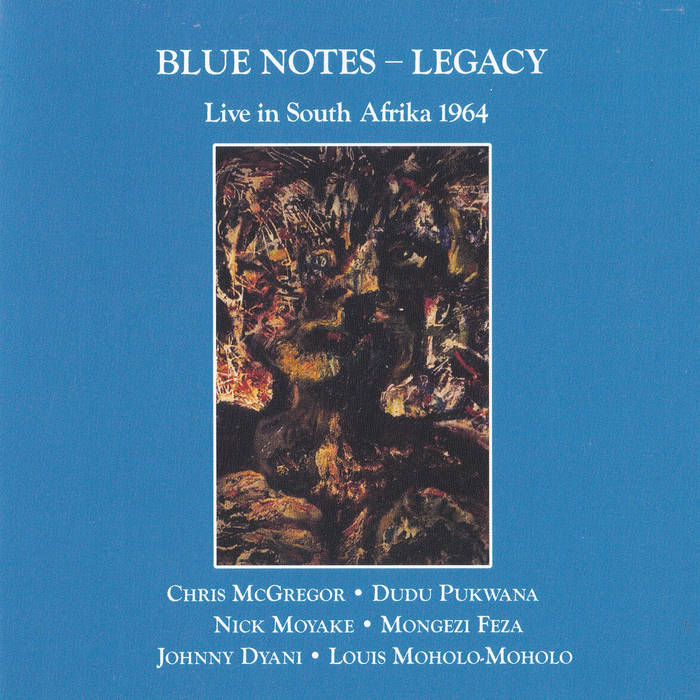
The Blue Notes “Legacy Live in South Africa 1964” (Ogun 1995, reissued in 2022)

If you would listen to fresh improvised or experimental music in 2020 or so, outside of Europe or the United States, you have to go to Mexico. If you would listen to something similar and at the same coordinates, but in 2010, you had to go to Turkey. There, in particular, you would be able to find musicians striving for their freedom of expression issuing new records and setting new collaborations, as the one with european genius saxophonist Peter Brotzmann and US incredible bandleader and multireedist Marshall Allen.

But what if you were searching for a new, exciting sound during the 1960s? Obviosly the answer would be: go to South Africa. There, despite of the apartheid, a bunch of simply brilliant and original musicians, mostly exhibiting through Universities or small clubs, were trying to overcome the barriers dividing people from people using music as a tool, as a device, as a peaceful weapon.

Why are you reading on this blog about this bunch of courageous musicians? Because label Ogun is now reissuing Blue Notes catalogue, and luckily enough last saturday, hanging around into some small record shops, I found out some copies of these records. In this review I will tell you about the live album Legacy – Live in South Afrika 1964, originally released only in 1995 because printing records of mixed bands during their lifetime wasn’t easy in the land of Nelson Mandela for many decades.

Legacy is a record that features the music of a sextet. The performers involved are pianist Chris McGregor, altoist Dudu Pukwana, tenorist Nick Moyake, trumpeter Mongezi Feza, bassist Johnny Dyani and drummer Louis Moholo-Moholo. This line up of The Blue Notes recorded in Durban this session of live music that, according to the first two pieces, Now and Coming Home, is more keen on Thelonious Monk as far as themes and development.

Life was not easy for a racially mixed band in the 1960s in South Africa, and so they moved quickly to London where their influence on both improvised scene and the so-called Canterbury Style was highly praised during the decades, giving the musicians involved the opportunity to become keener on a less non idiomatic and more direct way of expressing themselves through music, or the possibility to expand their palette with one foot into jazz and not only into rock style.

McGregor and his pals gave life to the Brotherhood of Breath when in the UK, but this record from the ‘segregation era’ is vivid, pulsating and interesting. If the first and second tracks are monkian as we have written here above, with I Cover The Waterfront they give life to an intense cover of a classic from the jazz repertoire; in listening to it one wonders what if they would have played it at the Juan-Les-Pins festival the same year. I strongly believed a black panther like Archie Shepp would have approved.

Two for Sandi is an original by Dudu Pukwana reminiscent of the bebop or post bop era, where he gives life to an incendiary performance along with his friends reedists, starting from Feza, after a quick introduction and a tutti-exposed theme. After some rest, with the mid tempos of McGregors’ Vortex Special, where the solos of alto (Pukwana is simply telling a story with all its nuances in there) and trumpet (Feza expresses himself through different colors and shapes here), while the tenor of Moyake plays far beyond the limits of a human voice as this particular saxophone is compared, there’s time for a little hommage to Miles Davis and So What thanks to the piano and reeds, before going back to the main theme of the original composition.

B My Dear and Dorkey House are a couple of themes from Pukwana. The first is a ballad still indebted to Monk, as the title itself can suggest, with an evocative tutti from the three horns which gets a round of applause by the audience, followed by a beautiful piano solo, while the last piece is another hommage to bebop, with flamboyant solos by Pukwana himself, Feza and Moyake. Far from being pure improvised music, this album shows a love for different traditions in the jazz area but with a cooperative more than a conflicting attitude.

In fact, the musicians are proud to expose their style and sound but without fighting for being recognized as the best performer over the others: we can feel yet that cooperative mood that from the following decade will hopefully become the norm in the jazz world. But the importance of this record is that of a hystorical testimony for all those who are interested in how jazz music had an impact on different lands and traditions, and how these new expressions modified the process in the mainstream communities of the free jazz and avant garde era. 


Monday, September 6, 2021

Orchestre Tout Puissant Marcel Duchamp "We're OK. But We're Lost Anyway" (Bongo Joe Records, 2021)

In 2011 or 2012, when I wanted to quit writing (and I did for quite some years devoting myself to photography) I wanted to leave with a couple of articles: an interview with young Stefania ‘?Alos’ Pedretti (available on the italian webzine Mescalina) and an article about a young photographer (available on the italian webzine Culturame). But, what made me quit writing? It’s simple: the quality of the music I was listening to at the time.

Something was going terribly wrong. I listened to a lot of young musicians in London the year before and if I loved the ‘great old men’ of the avant-garde (Evan Parker, Louis Moholo-Moholo to name a couple) on the other hand I felt little or no empathy with the young improvisers or experimental musicians, with some notable exception. And I was feeling as Mr Jones (as in Bob Dylan song Ballad of a Thin Man, when he sings “And you know something is happening but you don’t know what it is, do you, Mr Jones?”).

So my idea was: “I don’t know where the music is going, I know only it is going badly, in sad places, so I want to explore art as an artist in order to understand better, on my own skin, what’s going on”. So I did photography and then theatre for many years, and finally I came back to writing. It was not a dramatic come back. I was always putting a review here and there, even in this blog. But finally, thanks to a colleague, I found out the perfect album to talk about this lost decade. 

The Album is “We’re OK, but We’re Lost Anyway” (great title, indeed) by the incredible Orchestre Tout Puissand Marcel Duchamp. An italian magazine of music made me aware or these guys, and the first time I listened to their music through youtube – a mix, as Stefano I. Bianchi wrote on Blow Up, of ‘afrobeat, Ex, Stereolab, Folk, jazz’ – I felt this sense of melancholy and sadness that was not coming from the notes played by the musicians, but kind of ‘in between’ the music, but being the most part of it.

So I kind of felt that all the sadness for the lost of music – there are only few record shops left in my town where I can find CDs or vynils of free jazz, improv and contemporary music and I hate Amazon so there’s no way I’m gonna use it to purchase records, plus the last one was kind of a ‘lost’ decade: I mean, apart from few musicians, even apart from the musicians you’ve found during this years on Complete Communion there was not that much great music to listen to – was here, better said: instead of listening to a new record, I was listening to all the sadness of the decade. 

This is the best part of “We’re OK ...”. But before analysing the album, few words for the band. The orchestra has born in Geneva in 2006, thanks to the bassist Vincent Bertholet who basically wanted to give life to a group of musicians who could play together around Europe. Initially fueled by six players, the band during the years became a 12tet and now it is a band of 14 elements. The band has a kind of political consciousness that makes it very nice to my ears and heart.


“From Mexican Zapatists to Chiapas rioters, we stand aside every person who wants to destroy capitalism through the dismantling of great commercial empires in favor of local agricultural enterprise” states Bertholet, and this is really the less we can do in this world right now. But what about the music? After an introduction so heavy, the music has to be at least incredibly good. And it is, even if its best part for me is I won’t say ‘not intended’, but ‘unconscious’. 

The album opens with Be Patient, where an accordion lead the listener though his microtones and minimal melody to Bertholet patterns embellished with violins twirling around the bass. Then drums and horns enter. The atmosphere is full of rage, while we start listening to the voice. If I have to make a comparison, the last Portishead come to my mind. But the trombone and the guitar mumbling together comes from experimental music, and so memory goes to records for instrumental ensemble and voice like “Les Stances A Sophie” and “Raining on the Moon”.

Empty Skies shows us what drums and strings can do if combined together exploring repetition through different pitches. Voice sweetens the listener while guitar and strings develop a distorted unison that is possibly what made Bianchi, the italian journalist above, think about the Ex (accompanied by Tom Cora I guess). So Many Things (To Feel Guilty About) is based on the dynamics of a guitar counterpointing a vocal chorus. Drums give depth to the ensemble, vibraphone too as it takes its turn. 

Blabber, as I was hoping to hear, is opened by vibe and drums, plus cello and voice playing a game of underlines to which all strings add tasty spices here and there, while We Can Can We is driven by horns, cello and drums. The rhythm is undoubtely that of Fela Kuti’s music, with a guitar dipped into minimalism as the vibraphone. Flux is a delicate journey into a dream made of horns, voice and vibraphone, whereas guitar adds a punk rhythmic ad a certain point. Drum’s colors set on fire the male rap, again with the guitars developing a rock drama made of multiple grating.

Connected is a couple-of-minute-divertissement for chorus and guitar, Beginning, the last five minute track on the album is their first song I listened to in a live version you’ll find at the end of this review, and it is made of a rhythm mimicking the circularity of afrobeat with a minimalist guitar and multiple horns, percussions and strings to set the music on fire. It has that warrior spirit, but also that not intended but real melancholy I was telling you more above. But the silence is over.

The album terminates with the one and a half minute of Silent, the closing of the courtain with a pinched cello, strings, voice and the desire for an uprising. My dream now is to take the band to play a live concert in one of the many squatted centers in my town. Maybe, having some contacts, this will be possible in the future. It really would be the best venue for the Orchestra’s fire music and at the same time, the encounter point for an awakening of both music and people. Together.