Sunday, March 20, 2011

Brotzmann / Kondo / Parker / Drake - Die Like A Dog (4CD Box, Jazzwerkstatt, 2007)

"This ticking is most terrible of all – / You hear the sound I mean on ships and trains, / You hear it everywhere, for it is doom; / The tick of real death, not the tick of time; / The termite at the rotten wainscot of the world – / And it is death to you, though well you know / The heart's silent tick, the tick of real death, / Only the tick of time-still only the heart's chime / When body's alarm wakes whirring to terror." (Malcolm Lowry, Thirty-five Mescals in Cuautla). Brotzmann's Die Like A Dog Quartet is one of the most intense live act you could meet on earth. Music is provided by four master musicians: Brotzmann aside, trumpeter Toshinori Kondo, bassist William Parker and drummer Hamid Drake are the core of this project. 

The quartet is one of the highest peaks in impro's world, mixing and distilling the quintessence of music: the bright, spiritual side of Drake's and Parker's spiritual visions with the abrasiveness and iconoclastic clash of german multireedist and japanese electrified and distorted sound. Die Like A Dog takes his name from both Albert Ayler's death and Malcokm Lowry's Under The Volcano. In fact, Ayler's death is still wrapped up in mystery, his body found on the bank of New York City's East River in November 25, 1970, 20 days after his disappearence. Probably, a suicide. The last pages of Lowry's literary masterpiece are devote to the death of his principal character, the consul, an alcohol addict of whom, during the novel, we discover life and sentimental struggling. The last image of the novel is the consul plunging into a volcano followed by his dog. Philosopher Gilles Deleuze wrote beautiful pages about this novel and alcohol adiction, anyway the music on this four CD set provided with a beautiful 32 page booklet (full of b/w photos and essays both in German and English) is violently and abstract impressionistic. 

Only in Fragments of music, life and death of Albert Ayler, captured live (as the other three sets) in 1993 in Berlin, at the Townhall Charlottenburg, short quotes from Ayler themes are presented, iterspersed with acid and rough solos, duos and ensemlble telepathic wild interplay; the other three records (Little birds have fast hearts no. 1 and 2 come from the 1997's 30th Total Music Meeting, Aoyama Crows was recorded in 1999 at the Podewil, in Berlin) are less related to Ayler semanthics and are defined by a dense, buoyant and abstract feeling. Kind of a mixing between music and painting, where we can recognise and appreciate Brotzmann mastery in both arts at the same time.


Tracks and Personnel

Fragments of music, life and death of Albert Ayler
Tracks: No. 1; No. 2; No. 3; No. 4
Personnel: Peter Brotzmann: alto and tenor saxophones, tarogato; Toshinori Kondo: trumpet and electronics; William Parker: bass; Hamid Drake: drums.


Little Birds have Fast Hearts No. 1
Tracks: Part 1; Part 2.
Personnel: Peter Brotzmann: tenor saxophone, tarogato and clarinet; Toshinori Kondo: trumpet and electronics; William Parker: bass; Hamid Drake: drums.

Little Birds have Fast Hearts No. 2
Tracks: Part 3; Part 4; Part 5; Part 6.
Personnel: Peter Brotzmann: tenor saxophone; tarogato and clarinet; Toshinori Kondo: trumpet and electronics; William Parker: bass; Hamid Drake: drums.


Aoyama Crows
Tracks: Part 1; Part 2; Part 3; Part 4.
Personnel: Peter Brotzmann: tenor saxophone, tarogato and clarinet; Toshinori Kondo: trumpet and electronics; William Parker: bass; Hamid Drake: drums.


Die Like a Dog Quartet - Jazz Festival Berlin 1995

Wednesday, March 16, 2011

John Giorno @ Cox 18

VENERDÌ 18 MARZO 2011
dalle 22.08

ricordando Primo Moroni
reading di John Giorno
La rassegna “scali di parole” giunge al suo 5° appuntamento ospitando un reading di John Giorno.
“Scali di parole” nasce lavorando all’archivio Primo Moroni: tra le migliaia di volumi che costituiscono l’archivio, si è arrivati a catalogare anche i libri di poesia e da lì è partita l’idea di organizzare una rassegna poetica in Cox18. L’appuntamento di questo mese è in particolar modo dedicato a Primo Moroni.
Primo invitò alla Calusca molti poeti, tra cui Lawrence Ferlinghetti e Lance Henson. “Scali di parole” tenta di portare la poesia e il suo messaggio di liberazione fuori dai circuiti commerciali o istituzionali (gallerie, musei …) per tentare di dare corpo all’inerenza tra forma e contenuto…

John Giorno è nato a New York nel 1936, ma è originario di tursi in provincia di matera. vive, da sempre, a new york.
E’ uno dei più importanti poeti e performer della seconda metà del XX secolo, e la sua storia e attività continua agli albori di questo XXI.
life is a killer è il titolo di una poesia di john giorno del 1981, espressione poi ripresa in diversi printed-poems (uno dei quali è riprodotto nella locandina della serata).
Sia in ambito letterario che in quello visivo la sua esperienza e pratica è un’esempio di pop art applicata ai testi.
Lunga la lista delle sue amicizie e collaborazioni: william s. burroughs, brion gysin, andy warhol, robert rauschenberg, jasper johns, patti smith, laurie anderson, philipp glass, glenn branca, hüsker dü, sonic youth, diamanda galas, keith haring… che hanno collaborato con lui per l’etichetta giorno poetry systems fondata nel 1965.
Nel 1984 fonda ‘’the AIDS treatment project’’ che si occupa del sostegno ai sieropositivi e ai malati di AIDS.

See http://cox18.noblogs.org/ for full infos.

Sunday, March 13, 2011

Mulatu Astatké @ Rome, Auditorium Parco della Musica 03/10/11

I landed in Fiumicino Airport at about 4 p.m., last tuesday ... a busy afternoon (going to the city by bus, checking my room, eating something, seeing a  Nam June Paik exhibition I got to write about in the next days ... ) but after all, it was well worth. Mulatu Astatké is currently touring with a septet: multi-reed (flute, clarinet, tenor saxophone), trumpet, keyboards, cello, viola, bass, drums and percussions. Spanning through his old and new repertoire, Mulatu gives new shape to old songs like Yèkatit and Tezeta, as far as new compositions like Mulatu's Mood (from Steps Ahead, his latest record). 


Born in Djimma (in the south-west of Ethiopia) in 1943, at 17 Mulatu Astatké started traveling in UK and USA to study music and create his own bands and groups, giving shape to his music and ideas. In London he became familiar with latin-american music, that was the hot spot just before Beatlesmania. In New York, finally, he founded the Ethiopian Quintet (Afro Latin Soul, their first LP, was issued in 1966), with musicians for the most part from Puertorico. His music was something previously unheard: a mix of latin rhythms, ethiopic melodies, whereas in his native land no instrumental tradition (with the exception of military march-past, ethiopian various music styles are focused on singing, both in griots ancient tradition and in modern developments of popular music) nor caraibican music (the Imperial Body Guard Band, that backgrounded such diverse talented musicians as Getatchèw Mekurya, Thlaoun Gessesse and Mahmoud Amhed was provided with ethnic percussions, but with no latin tinges at all ... ) had their own proper place before.


This night Mulatu and his musicians gives music a stronger grooving sensation than the last time I listened to him with Either/Orchestra in Milan a couple of years ago, and his palette seems more 1970's oriented. Maybe because of his electric piano (very similar to the one Keith Jarret was using playing live with Miles Davis,  but without distortions and with a thin, spacey sound) and of a viola and a cello doubling and expanding the acoustic bass range on melody and rhythm. It's the same with flute and clarinet alternating with tenor saxophone and trumpet. An orchestral sound in wich single imprivisations are well fitted into the ensemble, giving the melancholic strangeness of ethiopian melodies a wider, intoxicating brightness.


Mulatu Astatké Discography

As bandleader

  • "Maskaram Setaba" 7" (1966, Addis Ababa Records, US)
  • Afro-Latin Soul, Volume 1 (1966, US)
  • Afro-Latin Soul, Volume 2 (1966, US)
  • Mulatu Of Ethiopia LP (1972, Worthy Records, US)
  • Yekatit Ethio-Jazz LP (1974, Amha Records, Ethiopia)
  • Plays Ethio Jazz LP (1989, Poljazz, Poland)
  • Ethio Jazz: Mulatu Astatke Featuring Fekade Amde Maskal
  • From New York City to Addis Ababa: The Best of Mulatu Astatke
  • Mulatu Astatke
  • Assiyo Bellema
  • Éthiopiques, Vol. 4: Ethio Jazz & Musique Instrumentale, 1969-1974 CD (1998, Buda Musique, France)
  • Mulatu Steps Ahead with the Either/Orchestra CD/2xLP (2010, Strut, Germany)

As a musician and collaborator

  • Tche Belew with Hailu Mergia & The Walias Band (1977, Kaifa Records, Ethipia)
  • Inspiration Information with the Heliocentrics (2009)

Compilation appearances

  • Ethiopian Modern Instrumentals Hits LP (1974, Amha Records, Ethiopia)
  • New York–Addis–London: The Story of Ethio Jazz 1965–1975 (2009, Strut, Germany)

Saturday, February 19, 2011

Don Cherry Quintets - Copenhagen 1963 - Hilversum 1966 (FreeFactory, 2010)

Another gorgeous Free Factory re-issue, from last years' ending. Five tracks, three from a 1963 Copenhagen concert, just few days after the quintet recorded Niel Holt's Future One soundtrack. Consequences was taken from that lp, and along with the opening Coleman's Emotions, sounds like Archie Shepp's Fire Music: hot rhythms, breathtaking horn blows, confrontational attitude: October Revolution in music. Time's up also for a pianoless, but touching, Monk's Mood. This show was broadcasted by Danish Radiohusets, and it seems that those three tracks would be all that remains.

Last couple of titles comes before Cherry recorded his Symphony for Improvisers and after trumpeter, with saxophonist Gato Barbieri, released Togetherness. Long Suite presents material from Complete Communion (recorded five months before), as long as a nervous rendition of Afro-Blue, which is very far from Coltrane's majesty, and Golson's I remember Clifford. Five players involved in this Hilversum sessions never recorded together again: Don will meet 'Leandro' on Le Depart (soundtrack for beautiful Jerzy Skolimowski movie), Haden's Liberation Music Orchestra and Gaslini's Nuovi Sentimenti; pianist/vibist Carl Berger and drummer Aldo Romano would be present on Togheterness sessions, but these 30 minutes of music are the only bassist Bo Stief took part in trumpeter discography. Sound quality's quite good, not excellent, but a couple of few seconds noise intrusions wouldn't spoil listener's enjoyment.

Tracklist: 01. Emotions; 02. Monk's Mood; 03. Consequences; 04. Exodus; 05. Suite (For the Children / Afro Blue / I Remember Clifford).


Personnel: Don Cherry (trumpet) with: John Tchicai (alto), Archie Shepp (tenor), Don Moore (bass), J. C. Moses (drums) - 01/03; Gato Barbieri (tenor), Karl Berger (vibes, piano), Bo Stief (bass), Aldo Romano (drums) - 05/06.

Friday, February 18, 2011

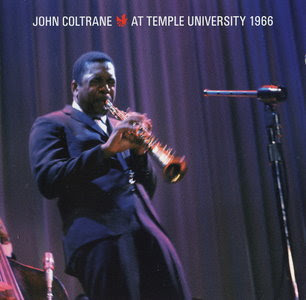
John Coltrane - At Temple University 1966 (FreeFactory, 2010)

This is probably the best recorded late Coltrane performance ever issued. Not as subversively noisy and harshly unconventional even for Trane standards of that time, as his Olatunji Concert (officially published in 2000 by Impulse!), this 1966 live exhibition of his last quartet gifts fans all over the world with one of the most beautiful renditions of  both Naima and Leo. Naima is here more organic than on Live at the Village Vanguard Again!, where piano and horns were less focused into a continuum; Leo (the studio version, a sax/drums duet, was published as a bonus on Interstellar Space cd reissue) presents Jimmy Garrison bass and Alice Coltrane piano on the very background, due to powerful argumenting of two saxophones and drums. Arcoed bass gives this rendition an ineffable sense of melancholy, but it's up to Crescent, a beautiful 1964 composition from the same titled record, to testify the state of Trane's mastery and even difficulties in developing further his style and language.

As Ravi Shankar states, in his liner notes, John Coltrane was looking (as ever) for something different. Indian sitar master points out at inner peace, at the pain of living he felt in crossing many jazz music of that time (and after all, Trane himself was looking for yoga meditation and Shri Ramakrishna teachings and relating his music to his inner struggling); but as far as this music from Temple University, what we hear it's a continuous, firm fire coming out of an injure that has already found a forged shape of expression. A record to listen to carefully, relating to the way Trane tries to cope with his musical architecture, always expanding it, whereas Pharoah Sanders gives shape to multiphonics and screaming lines that are as assertive as full of awareness. Alice Coltrane plays piano as harp, interlacing beautiful textures with Rashied Ali's wide open palette of percussions.

Personnel: John Coltrane (tenor sax), Pharoah Sanders (tenor sax), Alice Coltrane (piano), Jimmy Garrison (bass), Rashied Ali (drums)

Tracks: Naima (16.47) - Crescent (26:15) - Leo (20.43)

Tuesday, February 15, 2011

Anthony Braxton - 3 Compositions of New Jazz (Delmark, 1968)

Stunning Braxton's debut record as a leader is one of the milestones in defining and developing avant-garde AACM language and aesthetics, like its predecessor, 'Muhal' Richard Abrams' Levels and Degrees of Light, and second Braxton double For Alto. Along with Roscoe Mitchell's Sound, these albums signed an era with their intense expanding improvisation's palette and exploring new compositional territories, related to textures of sound and individual expression.

Multi-instrumentalism, the use of symbolic notation systems so to give improvisation and composition equal stress and new shapes, the relevance given to sound itself and its modulation along with silence, little instruments (bells, whistles, bottles), these seminal performances will influence improvised music for more than 30 years, and their inputs will give shape to a wider range of electroacoustic styles that will go beyond jazz. After all, Braxton's music is wide aware of avant-garde proper language: his interest in Cage's and Stockhausen's music will be developed in his parterships with the likes of Alvin Curran, Richard Teitelbaum and Wolf Eyes. Leroy Jenkins and Leo Smith have developed, spannig their careers, the intuitions this record witnesses, related to a new way of exploring their musical heritage (blues, r'n'b, gospel, above all). Muhal Richard Abrams is perfectly at ease with his debussian / impressionistic style, here at his rough and pointillistic, both energic and abstract peak. 

Personnel: Anthony Braxton (alto & soprano saxophones, clarinet, flute, musette, accordian, bells, snare drum, mixer); Leroy Jenkins (violin, viola, harmonica, bass drum, recorder, cymbals, slide whistle); Leo Smith (trumpet mellophone, xylophone, bottles, kazoo); Muhal Richard Abrams (piano, cello, alto clarinet).

Tracks: 1. (840m) -Realize-44M-44M, 2. N-M488-44M-Z, 3. The Bell

Monday, February 14, 2011

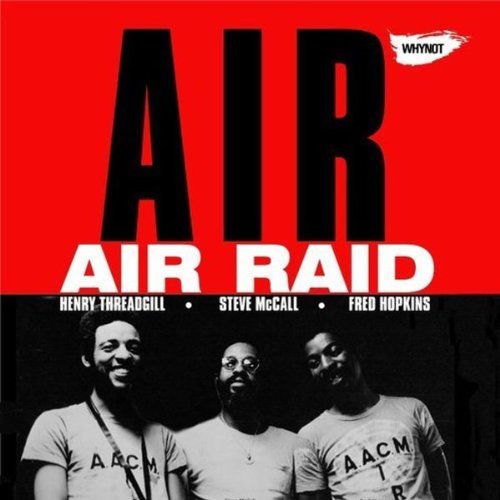
AIR - Air Raid (Whynot, 2010)


Last year was a breakthrough in Threadgill's long career: Mosaic and Soul Note / Black Saint reissues, PI new album, a couple of complete retrospectives published on Italian magazines (Blow Up and Jazz.It), not to mention The Wire. As far as reissues of his first trio, the one with Steve McCall and Fred Hopkins, Air Raid is probably his finest. Originally recorded in 1976, following previous year's Air Song, the album presents compositions in which players are allowed to take full control over interaction dynamics without backdropping any lead musician. Air Raid opens with Threadgill on chinese musette and alto offering a perfect essay in trio's art: suspension and strain (arco's vamping and droning doubled with exotic horns) rapidly reach their peak with alto/bass/drums nervous exchanges and then unleash the tension in sound/silence articulations. Fred Hopkins' harmonizations on Midnight Sun (beautifully lyrical and melancholic) reminds of Charlie Haden work with Ornette Coleman on pieces like Broken Shadows: both were opening tones, giving them an anchorage, offering a balance and broadening space in front of horn's full blown. Release is the lenghtiest composition of the record. Threadgill plays flute and hubkaphone, a self-built instrument, gamelan-like, made by putting together cars hubcaps. In Through a Keyhole Darkly plucked and bowed arco and brashes give a quiet setting for tenor balladry, givind the record a nocturne ending.

Henry Threadgill - tenor, baritone and alto saxophones, flute, hubkaphone; Fred Hopkins - bass; Steve McCall - percussion

Tracklist: 01. Air Raid - 02. Midnight Sun - 03. Release  - 04. Through a Keyhole Darkly