Sunday, March 4, 2012

After it’s Gone: The Music of Eric Dolphy [Pt. 1]


Words: Gian Paolo Galasi

Eric Dolphy and John Coltrane at the Village Gate 1961
"Whatever I'd say would be an understatement. I can only say my life was made much better by knowing him. He was one of the greatest people I've ever known, as a man, a friend, and a musician." (John Coltrane)

48 years after his death, Eric Dolphy’s discography is available almost in its entirety, and if his first wide appearance on a book is possibly an interview reported on 1971 in Black Nationalism and the Revolution in Music by American Marxist historian Frank Kofsky, in 2008 Guillome Belhomme issued his Eric Dolphy (Le Mot et Le Reste, ser. Formes).

Four years before Sardinian Festival ‘Ai Confini tra Sardegna e Jazz’ issued, in partnership with the cultural association Punta Giara, Tender Warrior: L’eredità di Eric Dolphy, accompanied by a CD containing a previously unissued Strenght and Unity along with other tracks featuring Tim Berne, Tiziano Tononi’s Nexus, MatthewShipp and David S. Ware. Again, in 2006 Otomo Yoshihide’s New Jazz Orchestra, featuring trumpeter Axel Doerner, sinewaver Sachiko M., baritonist Mats Gustaffson, multireedist Alfred Harth and circuit bender Toshimaru Nakamura ferried Dolphy’s last creative effort on a new perspective.

On the other hand, as the record butifully testify, it seems that Los Angeles multi-reedist’s music is badly suitable for a mere re-enactment: if you start to listen to a record as Out There (Prestige, 1961) you’ll find out how much his concept and practice of music is far out, as we’ll see.

"When you hear music, after it's over, it's gone in the air. You can never capture it again." (Eric Dolphy)

Los Angeles, 1954. Saxophonist John Coltrane was loosing his engagement with Johnny Hodges. Before the tenorist got rid of his drugs habits later on in 1957, deeply involving himself in developing his new music, he experienced the difficulties of handling a career between self destructive pushes and more creative efforts, even way before being hired and fired by Miles Davis more than once.

That was the first occasion the saxophonist met Dolphy, who lented him enough money to leave and get on the West Coast. On same year's September, Trane was playing again with the local Mop Dudley and his Collates, at the cross of 13th and Poplar, Philadelphia, trying to managing his musician’s career as a freelancer.  In 1959 John’s cousin, Mary, moved to New York, being into a relationship with trombonist Charles Greenlee. They lived in a house in Brooklyn, on 245, Carlton Avenue, belonging to Slide Hampton.

In that house lived for a while also trumpeter Freddie Hubbard, guitarist Wes Montgomery, saxophonist Eric Dolphy and Richard ‘The Prophet’ Jennings, a painter responsible for Dolphy’s first albums surrealistic covers. Dolphy’s influence on the more famous fellow became evident with time. At a certain point, Coltrane stopped playing soprano, and started playing flute (as on the album Expressions, Impulse!, 1965) so to enrich his palette of colours.

But influences and relationships between Coltrane and Dolphy, despite their strong friendship, reciprocal esteem and artistic partnership, were of a different nature in comparison with the coherent flowing of one’s music into the other that had place with Ornette Coleman and Charles Mingus with the altoist. Nonetheless, they were important and rich of fully enjoyable results. Trane and Dolphy first session was on May 23, 1961, for the tenor first Impulse! album, Africa/Brass.

An attempt to epithomize Trane’s efforts to date with his new quartet, with Jones polyrhythms, the bass of Reggie Workman doubled by Paul Chambers and Art Davis on the Africa takes, and the orchestra (featuring trumpeters Freddie Hubbard and Booker Little, trombonist Julian Priester, Eric Dolphy on alto, flute and bass clarinet, and Pat Patrick on baritone saxophone) enriching the quartet sound with a brassy, warm touch, it was followed by another pair of records that same year.

On the original Africa/Brass sleeve notes, the arrangements provided for Greensleeves were attributed to Dolphy, but, as McCoy Tyner explained (R. Coleman, The Real McCoy, Melody Maker, Jul. 18, 1964), Coltrane asked the pianist to write them down, while Dolphy was ‘copying my voicings’. All the arrangements were coming out of Tyner’s compings.

John Coltrane himself confirmed this last version (Clouzet/Delorme, Entretien avec John Coltrane, 1963). In fact, as Eric himself reported, “John thought of this sound. He wanted brass, he wanted baritone horns, he wanted that mellow sound and power”. But the only soloists on the sessions recorded by Creed Taylor at the Rudy Van Gelder studios were the quartet members, with the brass section (including Dolphy) limited to orchestral accompaniment on the background.

The second take of Africa is provided by some counterpoint going towards a more expressionistic attitude; even the double basses are underlining some passages with strong bowed interventions. The piece, focused entirely on a pedal point bass, more than on the beat and the classical 4/4 propulsion, was given a different plasticity, and is part of the constant evolution of Coltrane’s music.

Miles Davis and Gil Evans in Columbia Studios, 1959
This evolution will lead Coltrane around 1964 and 1965 to a constant decreasing of the use of chord progressions, while the use of bass pedal points was becoming the most part of the music structure. This direction is a consequence of Trane’s partnership with Miles Davis since 1958 – producing notably records like Milestones (Columbia, 1959) and Kind of Blue (Columbia, 1959). Here, the trumpeter and the pianist/composer were developing modality, in short a way to get out of the bebop harmonic complexity and to enjoy a new, wider and freer melodic framing, using modes instead of chord changes as a framework for the compositions.

While further developments of music led free jazz to focus towards polyphony as far as approaching the melody, Davis’ Kind of Blue and Trane’s Impressions (Impulse!, 1961) are considered the first accomplished results of the modal approach, and even if  the concept was firstly developed by pianist George Russell, with whom Davis had some discussions even before his 1949 sessions for the album Birth of the Cool, it’s interesting that, if Miles Davis from 1968 onwards pushed forward the use of rhythmic patterns and colors shifting of On The Corner, working also extensively on pedal points as Coltrane from 1961 on, the music of Eric Dolphy moves from different territories.

This is clearly audible trough a listening to Coltrane’s India, recorded live at the Village Vanguard on November 3, 1961, and released on the album Impressions. While Garrison, Tyner and Workman are providing sparse punctuations centered around a G major, echoing a tampoura-like drone, Trane solo on soprano is following a modal-rooted horizontal development, in some way forcing Dolphy to let off his intervallic practice on his bass clarinet.

Unluckily, Dolphy interventions with Coltrane’s quartet as also on the Live at the Village Vanguard rendition of Spiritual, opening track for the album recorded on the NY club, taste more or less like sketches, if taken on their own complex. Dolphy was gifted with a beautiful, rough and warm voice, making out of him the perfect partner for the likes of Charles Mingus and Ornette Coleman, but Trane’s music, even if their meetings are fully enjoyable and organic, having nothing of a pure mashup, they are far from a full, complete integration of their directions and further developments of composition and improvisation.


Elvin Jones and Eric Dolphy
“That's got to be Eric Dolphy - nobody else could sound that bad! The next time I see him I'm going to step on his foot. You print that. I think he's ridiculous. He's a sad motherfucker. […] It's a sad record, and it's the record company's fault again. I didn't like the trumpet player's tone, and he don't do nothing. The running is all right if you're going to play that way, like Freddie Hubbard or Lee Morgan; but you've got to inject something, and you've got to have the rhythm section along; you just can't keep on playing all eighth notes. The piano player's sad. You have to think when you play; you have to help each other - you just can't play for yourself. You've got to play with whomever you're playing. If I'm playing with Basie, I'm going to try to help what he's doing - that particular feeling.” 
(Miles Davis on Eric Dolphy Mary Ann, from the album Far Cry - Blindfold test by Leonard Feather, on Downbeat, June 1964)

Miles Davis with Ron Carter on bass and Tony Williams on drums
It is improper to say that Miles Davis and Eric Dolphy never met musically, or that they were two complete different worlds. Ron Carter, Davis bassist on his second quintet, played cello on Out There. On Dolphy’s recognized masterpiece Out To Lunch! (Blue Note, 1964), the drummer is Tony Williams – as on Andrew Hill Point of Departure, another recognized milestone of Bue Note's mid-'60s modernistic approach to post-bop. And Herbie Hancock is on piano on the previous year live album The Illinois Concert (Blue Note, 1963).

Thelonious Monk at the Town Hall, NY, 1959
On a book published in Italy on 2004 (“Tender Warrior – L’eredità di Eric Dolphy”, 2004), Italian journalist Claudio Sessa made a brilliant comparison between Dolphy and Thelonious Monk: “Monk is for bebop what Dolphy was to free jazz; both are substantially foreigners to the ‘genres’ they are generally associated with, even if they use some grammar elements and above all they love to work side by side with their major representative figures, recognizing their instrumental and expressive abilities, compatibles with their difficult aesthetics.”. Miles Davis reenactment of ‘Round About Midnight’ on his first 1954 Columbia record testify a similar effort to push himself ahead of the common bebop aesthetics and chops, a common ground that is really helpful to understand, through a comparison of the way Davis and Dolphy were using the same sidemen, their further developments.

Take for instance Eighty One, from Miles Davis E.S.P. album (Columbia, 1965), that is also the starting point for Herbie Hancock’s Maiden Voyage composition. At this moment in time, Davis’ music is developing involving rhythm shiftings, and if on Nefertiti, a couple of years later, his trumpet and Wayne Shorter’s tenor saxophone are repeating the melody, while drums, piano and bass are drawing continuously changing layers of different colors, anticipating the innovations that will lead him to develop a music in which rhythm patterns and their permutations will definitely replace harmony and melody as its primal coordinates the same way composer Karlheinz Stockhausen did with his Telemusik and Mixtur, on this 1965 piece Tony Williams rhythmic shiftings between bogaloo and swing, over which Davis draw his statements passing sinuously through them, are an anticipation of those further developments.

Five years before, on August 15, 1960, Eric Dolphy, Ron Carter on cello, bassist George Duvivier and drummer Roy Haynes recorded at Van Gelder Studio Out There, second Dolphy’s album as a leader. While the previous Outward Bound (Prestige, 1960) was still featuring the standard bebop line up (two horns, bass, drums and piano), containing also some standards as On Green Dolphin Street and Glad to be Unhappy, its follow up features four original compositions, mingusian Eclipse, Out There composed by both multireedist and bassist, Randy Weston’s Sketches of Melba and Hale Smith’s – a composer Dolphy was particularly impressed with since when playing with Chico Hamilton – Feathers, gifted by a guitar-like cello accompanying the flute.

If with the previous record Dolphy still showed to own a practice of harmonic intervals that is a full octave wider than Charlie Parker’s, gaining because of his restructuralist attitude  comparisons by music journalists with Ornette Coleman he would be bug with very soon, Out There sees Cuernavaca’s born bassist influence becoming heavy, without the album balance being compromise. One month before, on July 13, Dolphy was playing at the Antibes Jazz Festival in Juan-Les-Pins, France, with a quintet featuring Mingus, Ted Curson on trumpet, Booker Ervin on tenor, Dennie Richmond on drums and featuring Bud Powell on piano as special guest, anticipating with his bass clarinet solo on What Love his spectacularly fitting, abstract, harsh, abrasive and almost humorous approach to the October 20 sessions issued by Candid on Charles Mingus Presents Charles Mingus.

Clifford Jordan, Charles Mingus, Eric Dolphy and Dannie Richmond, 1964
Sparse tracks of this approach are available through second Dolphy’s effort as a leader on The Baron, a composition dedicated to the fellow, with Haynes and Duvivier pulsing around a vamp figure while Eric’s bass clarinet and Carter’s arco are following each other. Eclipse, a composition Mingus recorded for the first time on a 1953 Debut album, was originally written for Billie Holiday as a response to Strange Fruit; refused by the singer, the piece is melodically convoluted, and reminds of Schoenberg’s chromaticisms. In his entirety, Out There is a fearless and atypical exploration of tonality since the opening, daring title-track thorugh the lyrical, gritty harshness of Feathers’ intro.

“There is so much to be gained by examining Eric Dolphy specifically as a composer. […] Certainly, his efforts as an improviser and instrumental performer are interwoven, and ultimately inseparable, with his activities in composition. […] he worked with a remarkably broad vocabulary, […] His compositions show arguably a greater interest the potential of form and structure than that of non-structured environments.” 
(Graham Connah, Eric Dolphy, The Composer)

Born in Los Angeles, a city that since the end of WWII hosted composers Arnold Schoenberg and Igor Stravinskji, in his youth Eric Dolphy shared a junior college bandstand with minimalist composer La Monte Young. In his compositions he was taking the classic blues and AABA forms together with twelve-tone row and odd metered repeating vamps. G.W., from Outward Bound (Prestige, 1960) opens with a major 7th interval, resulting from a combination of an A-flat in the bass with a G played by alto sax and a F-sharp played by trumpet.

A polychord, or a standard major chord with an extra dissonant note, an exploration of unorthodox harmonies putting him on the same level of George Russell and Don Ellis in a period in which Ornette Coleman was putting the stress on the primacy of melody. Dolphy on his own, as Graham Connah underlined in his writing, is something of an ‘expansionist’, using intervals paying attention to their invertability and multifunctionality, and at the same time an indicator of his interest in the sounds of nature, as clearly audible by the way he plays the flute.

Influenced also by Italian contemporary flutist Severino Gazzelloni, met during Darmstadt summer courses and one of the favorite interpreters of composer Luciano Berio – we’re on the ground of post-serialism, with Berio’s 1958 Sequenza for solo flute as one of its accomplished, virtuosistic examples – Dolphy’s interest in free jazz, orchestral development of modality – see Oliver Nelson’s The Blues and the Abstract Truth (Impulse!, 1961), and contemporary avant garde music shows a restless and feverish research for the right instrument to express his music in the most proper way: “I want to say more on my horn, than I ever could through ordinary speech”.

Founded in NYC in 1960 as subsidiary of Cadence, and featuring writer and civil libertarian NatHenthoff as A&R manager and co-designer for the album covers with photographer Frank Gauna, Candid Label was the pure expression of the jazz avant-garde and of the civil right movements of the decade. Max Roach’s We Insist: Freedom Now! Suite, Cecil Taylor and Steve Lacy important albums were documented as Abbey Lincoln, Booker Little, Booker Ervin efforts, before Candid’s closing in 1961. Charles Mingus Presents Charles Mingus (Candid, 1960) can be considered as an important, accomplished step ahead in the development of bassist approach to small combos as Atlantic 1956 Pithecanthropus Erectus

While the latter was characterized by altoist Jackie Mc Lean as Mingus creative and fulfilling alter ego, listening to the former is clearly evident that Eric Dolphy changed over; if the transfiguration of a classic Gershwin tune as A Foggy Day (In San Francisco) on the 1956 record features the two horns mimicking the traffic of the Big Apple, on the independently recorded new album the standard What is this Thing called Love becomes What Love, whose pairing melody by Ted Curson and Dolphy develops into a meditative, Spanish-tiged lyrical trumpet solo, surrounded by bass and alto clarinet counterpoint, before being driven into one of the Mingus' favorite treatments. 

Tempo suddenly fastens and then freezes, or stops, leaving the soloists free in turn to insert diverting phrases, short, ironic quotes out of different songs, or affordances typical of Mingus modus operandi in which some phrases are taken from one section into another, and one of the most vivid dialogues between Dolphy and Mingus, both trying to imitate the human voice.

Folk Forms, at his second recording after the three months before performance featured on Live at the Antibes (posthumously issued by Atlantic in 1979 and presenting a still progressing integration between the two musicians moods and characters), makes clear Mingus idea of polyphony, that similarly to the New Orleans’ doesn’t have a primary reference voice and is overflowing straight to the solos, always developed as a dialogue or having another instrument on the background. Not by chance the twos were so much similar that with time their performances together will be more and more deeply marked by an almost telepathic feeling and aim sharing.

Two months after this sessions, and Eric Dolphy is taking part, accompanied by Don Cherry and Freddie Hubbard on trumpet, bassists Scott La Faro and Charlie Haden, and with Ed Backwell and Billy Higgins behind the drums, to the A&R Studio terms that will lead to Ornette Coleman’s masterpiece Free Jazz, issued by Ahmet and Neshui Ertegun brothers label on September 1961.

Originally provided by a beautiful clapper cover containing a reproduction of Jackson Pollock’s White Light, the 37 minutes of collective improvisation on the record have more than a similarity with the painter’s dripping techniques. Pollock used to let the colors flow directly from the brushes on the canvas layed down to the floor, trying to give a balance to what was under his direct control – his body, and the dripping itself, the gravity and the way the canvas was soaking the color.

During the sessions, Ornette Coleman divided the musicians in two quartets, taking Cherry, LaFaro and Higgins by his side, while prividing before playing the musicians some reference points through which let the music flow. As Gunther Schuller explains in his liner notes for the 1998 reissue of the record, Free Jazz is composed by six major sections flowing without interruption. Coleman, in order to lead each section, devised three types of ideas: “1) a brassy, atonal polyphonic flourish, heard at the very beginning of the performance and again several times toward the end; 2) a sustained atonal, multivoiced choralelike series of notes; 3) a unison ensemble line […] the musicians were admonished to avoid any recognizable elements sneaking in – tune fragments, quotations, tonal reminiscences, familiar riffs”.

Don Cherry with Ornette Coleman at the Five Spots, November 1959
While every musician is at the same time leading and supporting the music – what Ornette referred to as ‘harmonic unison’ – with the bassist walking on the middle (LaFaro) and low (Haden) registries, listening to the first take of the recording it is clearly audible that, after the collective entry, Eric Dolphy’s bass clarinet is more coherent with his usual harmonic and timbric clichés, as we heard through his previous works. Listening to the master take after that, it is almost surprising how much his inflections and tonalities have become almost ‘harmolodic’. His journey through music shows how much his penetrability to his partners music can easily and amazingly turn into suppleness without any lack of personal expressivity.

It’s time to get back some months. It is July 16, and Rudy Van Gelder is about to record live, at the Five Spot – the same club that in 1957 hosted Thelonious Monk with John Coltrane, and first NY meetings of Don Cherry with Ornette in 1959 – a quintet featuring Eric Dolphy with Booker Little on trumpet, Mal Waldron on piano, Richard Davis on bass and Ed Blackwell on drums.

Dolphy had left Mingus groups some months before, while his sharing the lights with Coltrane led both to be in charge with Down Beat columnist Leonard Feather of being ‘anti-jazz’. And if the two musicians will answer directly from the columns of April 1962 issue of the magazine, this summer 1961’s was Dolphy’s first regular enlistment since then. Shared through three different records by Prestige (At the Five Spot Voll. 1 & 2, and Memorial Album), the music contained here is an attempt to summarize Dolphy’s previous experiences nowadays.

Booker Little, that sadly died on October that same year and is present with Dolphy on his Candid’s Out Front (1961) release, was recognized, also for the efforts of Nat Hentoff, as an innovator on his instrument, through a practice of dissonance as a device to widen the boundaries of the sound itself, in that a huge influence on contemporary players like Roy Campbell. Mal Waldron, a long time associate with Billie Holiday and Charles Mingus, and later on widely appreciated as the perfect partner for Steve Lacy’s angular soprano saxophone, is playing here in a way that, since the opening Fire Waltz, a composition of his own, put him directly on the same lineage of Monk – another proof of his mastery is the piano itself, mostly out of tune, Mal ran into the club, but that through the decades has become one of the many delights of this recordings.

Ed Blackwell with Charlie Haden
Richard Davis (Ahmad Jamal, Don Shirley, Sarah Vaughan) will be present moreover on Dolphy’s masterpiece, Out To Lunch! and Andrew Hill’s Point of Departure (Blue Note, 1964). If his presence outside of the jazz world is guarantee through providing ‘the greatest bass ever hear on a rock album’ (Greil Marcus) to Van Morrison’s Astral Weeks, his activity will lead him to be teacher of William Parker, a solid reality of today’s avant garde jazz world. Through tracks like The Prophet, a composition from Dolphy’s first record as a leader – interesting the comparison with Roy Haynes melodic rendition of rhythms, and Little’s Aggression, Blackwell particular melting of African polyrhithms, New Orleans and bebop gives reason to Ornette Coleman in choosing him as first pulse of his arson records The Shape of Jazz to Come and This is Our Music (both Atlantic, 1960) and to trumpeter Don Cherry for the beautiful duet albums Mu 1st & 2nd part (BYG Actuel, 1969), in which the drummer deepend his coloristic approach to melody and rhythm through a broader use of small and ethnic percussions.

“Dolphy pursued freedom through a run in with a structure to prowl, to climb over, to shatter. The same with the rhythm” (Marcello Piras)

Related Discogarphy
John Coltrane, Africa/Brass (Impulse!, 1961)
John Coltrane, Impressions (Impulse!, 1961)
John Coltrane, Live at the Village Vanguard (Impulse!, 1961)
Eric Dolphy, Outward Bound (Prestige, 1960)
Eric Dolphy, Out There (Prestige, 1961)
Eric Dolphy, At the Five Spot, Vol.1 (Prestige, 1961)
Eric Dolphy, At the Five Spot, Vol. 2 (Prestige, 1961)
Eric Dolphy and Booker Little, Memorial Album (Prestige, 1961)
Ornette Coleman Double Quartet, Free Jazz (Atlantic, 1961)
Charles Mingus, Pithecanthropus Erectus (Atlantic, 1956)
Charles Mingus, Charles Mingus presents Charles Mingus (Candid, 1960)
Charles Mingus, Mingus at Antibes (Atlantic, 1979)
Miles Davis, E.S.P. (Columbia, 1965)
Miles Davis, Nefertiti (Columbia, 1967)

Related Bibliography
Lewis Porter, John Coltrane His Life and Music (The Michigan American Music Series, 1998)
VA, Tender Warrior L’eredità Musicale di Eric Dolphy (Associazione Culturale Punta Giara, 2005)
Stefano Zenni, Charles Mingus Polifonie dell’Universo Afroamericano (Stampa Alternativa Nuovi Equilibri, 2002)


Friday, March 2, 2012

Allen Lowe - Blues and the Empirical Truth [Music and Arts, 2011]

Words: Gian Paolo Galasi


Allen Lowe, Marc Ribot, Lewis Porter, Ray Shury, Jake Millet
Did you ever felt a deep struggle, listening to some records, to be aware that you are listening to amazing music but that the project is maybe at risk of being lost in the big sea of today's huge amount of releases? 

If so, you can deeply understand  what I'm feeling everytime I give a spin to Allen Lowe's last year effort, the three CD + 12 page booklet set - have you ever complained for a 3 cd set nowadays? now's the time to change yer mind - that under the title of The Blues and the Empirical Truth collects 52 compositions in which the now Portland-based multi-reedist and guitarist shows to the world what does it means to take blues, gospel, cakewalk, Albert Ayler, hollers, The Carter Family, and Cripple Clarence Lofton, and to use creatively that kind of DNA and tracks giving life to a music, as Lowe himself observes, born of 'things lacking in the music world, or at least I perceive to be lacking'. 

Born in Massapequa Park, NY, in the 1950s, Allen Lowe started playing saxophone in jazz groups aged 15, at the Slugs Saloon - Charles Mingus and Ornette Coleman played there - finalizing his education with Super Sessions (Al Kooper and Mike Bloomfield), Grateful Dead, Louis Armstrong and The Mothers of Invention. 

Roswell Rudd
Right in the middle of the Seventies, he befriended Al Haigh, Curly Russell, Bill Triglia, Dick Katz, Tommy Potter, and met Lenny Tristano, Jaki Byrd and Art Pepper. Finally relocated in New Haven, Connecticut in the '80s, Lowe started playing with David Murray, Julius Hemphill, Don Byron, Roswell Rudd in clubs as the Knitting Factory and for Enja - for which he recorded the first reenactment of Blind Willie Johnson's Dark Was the Night, Cold Was the Ground - and Music and Arts labels. 

Director of Jazz in New Haven in the 90s - a free outdoor summer festival that featured Tony Williams, Max Roach, Freddie Hubbard under Lowe's artistic direction, once moved to South Portland, Maine, after a period of inactivity the musician took again guitar and composing, learning sound restoration while working on books as American Pop from Minstrel to Mojo (issued by Cadence with a 9CD set), The Devilin' Tune: A Jazz History 1900-1950 (issued by Music and arts with a 36CD set), and Really the Blues? A Blues History 1893-1959, the last two published without any institutional financial support. 

Mattew Shipp
While Allen Lowe's modernistic approach to music is widely recognized as enriching the matter he's digging, and highly praised by the likes of the composer Anthony Braxton and journalist and author Greil Marcus, the 3CD set of The Blues and the Empirical Truth is not only structured around Lowe's deep knowledge through his 'restructural' skills on the blues and folk tradition, and by his almost harmolodic-flavored alto saxophone - as in the Mingus-inspired, cubist boppish moans of Blues and Transfiguration, C-melody sax, tenor sax and guitar, but also embellished by Matt Shipp's piano and farfisa, Marc Ribot deconstructive attitude, Roswell Rudd and his trombone - particularly brilliant as on Manhattan Moan, and a well-trained assembly of lesser known - but highly expressive - players as guitarist Ray Suhy - listen to his duo with Lowe on The Children of Ella Mae Wiggis, altoist Spike Sikes, bassists Jessie Hautala, Derek Reynolds and Chris Day, pianist Lewis Porter, singer Todd Hutchinsen and drummer Jake Millet.

Marc Ribot
There aren't collective renditions on the album, but small groups - from duets to quintets - and a multi-layered attempt to give life to new music welcoming the most diverse and brilliant approaches to the music matter itself. Take for instance No 5 No Flats No Sharps Blues, inspired by both the attitude of the classic Delta singers to stay on the chord changes while keeping themselves instrumentally on the 1st chord with the non-synch typical of Ornette and Don Cherry, or the field hollers inspired Mama, Mercy Comes in Spurt duet between Lowe's Richard Hell-flavored guitar and the almost metaphysic Shipp's interpretation of a ragtime; or again, the cross pollination between the White Folks and The Primitive Baptists, reminiscent of John Zwed's essays on the creolization of American music and embellished by a brassy Sikes' alto solo, whose alternation with Suhy's guitar statement is the kind that fully explains their value even outside a record like this one.


This set is one that really make you understand how music can be fully enjoyable, while rich and complex at the same time, as on the 11 minutes of Reconstruction Dreams (The Ballad of Blind Tom), dedicated to Blind Tom Bethune, one of the many nuggets Lowe's attitude to dig out of the history of music put newly the lights on. Blind Tom was a possibly autistic slave, born in 1849, that from early childhood started touring as a pianist due to his brilliant technique and his ability to replicate any music he heard, while writing on his own spiritual and expressionistic pieces that are almost philosophycal reflections on the human condition through music; the long suite Lowe, Ribot, Porter, Huatala and Millet dedicate to his memory is, as the other compositions herein, an attempt to give back to present life the richness and the deep charm, beyond mythologies and narrations, the music in his forming is able to communicate to who listen, as the quote - better said: the invitation - by Miles Davis reported on the back cover can testify.


Wednesday, February 29, 2012

Café OTO - Note by note, the making of the avant-garde

Words and photos: Gian Paolo Galasi


The Thing (Mats Gustaffson, Ingebrigt Haken Flaten,
Paal Nilssen-Love), October 3, 2011
If you're a passionate lover of experimental music and would like to hear the refined textures of saxphonist Roscoe Mitchell, the prolonged and hypnotic blues moans of Loren Mazzacane Connors, the harsh, devastating haikus of Keiji Haino, composer Charlemagne Palestine teaming up with younger avant/droner Oren Ambarchi, or dazed and surprised by younger or still not wider recognized talents such as guitarist Havard Skaset, or pleased by the genius of a rare performance by CC Hennix, Café Oto in Dalston, Ashwin Street, is the must-go if you're having a trip in London or residing in the UK's capital. 

Martin Brandlmayr, Cafe Oto, Sept. 30, 2011
Open since 2008, Cafe Oto - 'oto' meaning 'noise' in Japanese - is the ideal venue in which to enjoy the best in live avant garde music nowadays, introduced by the notes of John Coltrane's Kulu Se Mama, Moa Anbessa by The Ex featuring Getatchèw Mékurya before the beginning of the concert, or the likes. 

Spanning from AACM experimental jazz to European radical improvised music, from electro glitch to avant rock, from obscure folk heroes to weekly Eddie Prévost seminars, Cafe Oto's program is one of the most rich, in the city, full of concerts every day of the week. 

Oto's calendar is managed by CIC Otoprojects, a non-for-profit organization responsible also for special events, as last April Peter Broetzmann residency in celebration of his 70th birthday and the first Tentet's performance in London, or this year panel discussion, in collaboration with the art agency Electra, with composer Ghedalia Tazartes with Mark Harwood of Penultimate Press. Oto team is also curator of the selection for the Free Music Archives, an interactive library of high quality legal audio download.

Rogelio Sosa, Sept. 30, 2011
But Café Oto is not only the  place in which to listen to always fresh and exciting music. As in every music club worth of its value, merchandising blossoms as music, with the same attitude.

Here you'll find the CDs, vinyls, leaflets provided by the musicians themselves, often in collaboration with local graphic designers. Finally, Café Oto is opening its own label, Oto RUKU, dedicated to document, share and support Oto's activity. 

The first release, available since March 26, 2012, is the 180gr vinyl of Peter Broetzmann/John Edwards/Steve Noble ... the Worse the Better, a performance recorded at the club in January 2010, and gifted with a beautiful two color Broetzmann's silkscreened artwork printed on acid-free archival card stock. As celebration, on March 28, the three musicians will reunite for a concert, while in the meantime is still possible to preorder the vynil and, since 26 March on, the record will be available also as digital download.


Café Oto
18 22 Ashwin St
Dalston, London E8 3DL

Peter Broetzmann/John Edwards/Steve Noble '... The Worse The Better' Lp Launch
Wednesday March 28 2012 
Doors: 8pm


Monday, February 27, 2012

Massimo De Mattia / Zlatko Kaucic - Freedom through Music

Words: Gian Paolo Galasi


Music is born free. Its path is a return to freedom - Edgard Varèse


Sometimes you meet music able to lead you through the path you're still covering towards unexpected regions; sometimes, giving you hints for your further explorations. That's what happened to me when I first ran into the music of Massimo De Mattia and Zlatko Kaucic. 

My first listening occurred last year, when the Italian webzine Mescalina gave me a record issued by label Setola di Maiale dedicated to Pier Paolo Pasolini, George Bataille and Jean Genet. Unusual territories for an improviser, but well known to me through my exploration of literature, theatre and performance art. 

Though I never saw live De Mattia and Kaucic, I retrieved Kaucic Tolminski Punt, more or less in the same period I was interviewing Peter Brotzmann, present on the record as a guest. Even when I was in London, Massimo de Mattia was sending his new works to me via mail, and thanks to his collaborations I ran into the music of Lanfranco Malaguti. 

After reviewing Panorami for my alter blog london_resonance, I had some short but interesting dealing with the guitarist, and both his highly personal compositional methods and his opinion on Derek Bailey and other topics became an interesting balance to what I was listening in UK's capital in those days. 

That's the reason I want to start a little introduction to recent releases of two musicians that, from their own regional borders, are still diffusing some of the most intriguing compositions and sounds you'll find traveling trough Italy. 

Massimo De Mattia is born in Pordenone, on 1959. Self taught flutist and composer, he started his activity in the 1970s with Lanfranco Malaguti, Bruno Cesselli, U.T. Ghandi, Gianluigi Trovesi and Ares Tavolazzi. His debut as a leader is 1993 with the record Poésie Pour Pasolini

In his most recent years artistic director of the review Schermosonoro and founder of Zerorchestra in his homeland, De Mattia explored through music important figures of XXth Century culture as painter Egon Schiele and actor, poet, theatre writer and theorist Antonin Artaud with younger pianist and composer Giorgio Pacorig. 

With great sensitivity, and with more than 20 records only under his own name, Massimo De Mattia during his career developed and showed a personal approach to both timbre and composition comparable to the most important European and worldwide recognized musicians of his generation. His approach to literature, poetry and painting melt different, often synesthetic suggestions into a coherent canavas through nervous and oblique flows of energies, charms and balances.

Zlatko Kaucic, born in Postumia (now Slovenia, then Jugoslavia) is an accomplished drummer, percussionist, composer. In his career Kaucic toured intensely through Europe - mostly Swiss, Spain, Holland, playing with improvisers like Irene Schweizer, Tete Montoliu, Kenny Wheeler, Steve Lacy, John Lewis, Louis Moholo Moholo.

Kaucic music is the result of his journeys through different styles - his first listenings to prog rock as P.F.M., Van Der Graaf, Genesis, the Blue Notes' south african free jazz, Max Roach and Billy Higgins and his direct experience through contemporary dance, bossa nova, radical improvisation.

When Kaucic went back in Slovenia, he finally turned on to his roots, adding stories and folklore from his own country to his improvising tips, in order to give life to expressionistic constructions. He started also to teach music and increase his experiences through new collaborations - Mauro Negri, Gianluigi Trovesi, Javier Girotto. 


Zlatko Kaucic - Tolminski Punt (Splasc(H), 2007)

Taking inspiration from a rebellion ended in repression in the village of Tomlin in 1713 for excessive taxation on meat and wine, this work in seven movements for violin (Rahela Grasselli), cellos (Barbara Zorz, Eva Julija Recnik), drums (Zlatko Kaucic) and horns (Peter Brotzmann on tenor, clarinet, tarogato) is composed by a first, immaginific string dialogue mixing folkloristic atmospheres and contemporary glissandos and shiftings, counterpointed by flurries of pointillistic and concrete drawings of percussions. After the first four movement, the fifth sees Kaucic and Brotzmann involved on a 40 minutes dialogue full of tension, rage, climaxes chiseled with a clear and almost telepathic attention to the details. Not only than another occasion to measure Brotzmann - and his partner - ability to channel energy into a clear cut and intense dialogue, this second part of the record gives also life to a real narration way ahead every common cliché of free improvising. 


Massimo De Mattia - Atto di Dolore (Setola di Maiale, 2011)

The sound of Eros, a vision belongin to French philosopher Georges Bataille, but also to writer and Black Panther activist Jean Genet, and to Italian poet and director Pier Paolo Pasolini, is the point of departure for a record full of concrete, subtle, almost metaphysic energy. P P P, an accompaniment to Pasolini's La Ricotta, is texturized by De Mattia's flute, full of vibratile and ancestral tension, and Denis Biason's subtly spectral guitar. Both are conjuring to take off and tidy expressive coordinates and shapes beyond linear codification, while Bruno Cesselli on piano and Zlatko Kaucic on drums, as in Hot God, are finally chasing the matter while capturing the fine river built by the two fellows - there is also a duo release by De Mattia and Biasson on the same label. Every note is amplified by another instrument, while most of the times pauses have the value of a heal up. The zenith of those dynamics are in Mater, to Susanna Pasolini, where eardrums and strings are responsible for the opening of a meditative space where the flute draw a disquieting flux. 


Massimo de Mattia - Mikiri + 3 (Setola di Maiale, 2011)

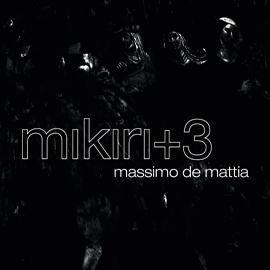
The quartet of the previous record is here added with Luca Grizzo (voice, percussion) and Romano Tedesco (accordeon). Resulting are seven original compositions plus two oblique and subtly nervous renditions of Jimi Hendrix Who Knows and Thelonious Monk Pannonica. The dynamics involved here are wider, due also to a direct use of piano lyrical possibilities. But if the opener Senci is melancholically straight, giving an essay on the players command on nuances and subtleties, Mikiri ('Cut with the look') is a composition that, with his resolute manner and dense sound, remember the attitude of the Cecil Taylor/Bill Dixon bands without being a stylistic camouflage. Through the tracks, the listener is being constantly urged to enter in a music whose quality, more than a pure addition of density, is a complex, evocative interlacing of different colors, moods and shades. A ballad like Ave Maria shows how a folkloric tune can become a spiritual composition through subtraction, more than abstraction from the form. An interesting, not common hint on how to relate to the dynamics of sound beyond the dialectics of idiomatic and non idiomatic.


Massimo De Mattia - Giovanni Maier - Zlatko Kaucic
The Jazz Hram Suite (Palomar, 2011)

Double bassist Giovanni Maier is an old time collaborator with De Mattia and Kaucic, at least since 1993's Poésie pour Pasolini. Graduated in 1988 at "G. Tartini" conservatory in Trieste, he is developing a project for solo bass since 1994 through different releases. Active collaborator of Roscoe Mitchell, Butch Morris, Tiziano Tononi, Cecil Taylor, Anthony Braxton, Tim Berne, in this trio record, issued for his label Palomar, Maier shows a great affinity with his partners in creating on a live performance a music that lives on different levels. Possibly the less immediate of the group of record here reviewed, at a first listening the five movements of The Jazz Hram Suite can seem the most dry, sober, concise statement provided by its players but, after some close encounter, it can reveal a fascinating and capturing world of nuances and coexisting plans. A highly adviced experience.


Saturday, February 25, 2012

Die Schachtel: Past and Present of Experimental Music in Italy

Words and photos: Gian Paolo Galasi


Die Schachtel (t.: "The Box") is the name of a composition by Franco Evangelisti (Rome, 1926-1980) conceived as a staged action for mimes, projections and chamber orchestra but, since 2003, is also the name of an Italian label devoted to experimental music. Founders of Die Schachtel are Fabio Carboni and Bruno Stucchi. 

Passionate records collectors in their own words even before starting their own business, their project is perfectly in line with the history of the experimental music in our Country. Since the 1950s onward, the extreme cure for graphic details is a huge part of the heritage figures like sculptor Fausto Melotti, graphic designers Giovanni Pintori, Erberto Carboni, Gianni Sassi have left to the Italian experimental music history.

Not by chance one of the most acclaimed Die Schachtel productions, the 10CD+1DVD+Booklet+Poster box Musica Improvvisa, won the Design & Art Direction prize, while the website Hard Format put the team Die Schachtel/dinamomilano between the best examples on music design. Passion and quality, love and respect for a tradition, the one related to experimental music, whose history is still far from being rigorously unveiled to the present times. 

As both Carboni and Stucchi explained in an iterview for the Italian on paper magazine Blow Up in September 2011, "if Rai were like ORTF or INA-GRM, they would been publishing by themselves the treasures of their own immense archive, making an enormous favor to our Contry". It's a matter of facts that our Phonology Studios in Milano, for quite some time directed by Luciano Berio and Bruno Maderna, are still plenty of old tapes containing astouding performances by the likes, as an example, of Nino Rota and Salvatore Sciarrino.

A 4CD+300pgs booklet box containing experimental works like Sciarrino's Inferno and other  electronic music compositions that in the past won the higlhy praised Prix Italia is scheduled for this summer, while Die Schachtel catalogue, accessible also through mail order since 2008, is full of both reissues and original works. Some names, just to give the reader an idea: Phill Niblock, Alvin Curran, Claudio Rocchi, Henri Pousseur, Aldo Clementi, Gruppo di Improvvisazione Nuova Consonanza, Christina Kubisch are part of Die Schachtel catalogue. 

Waiting for the forthcoming box, here below you'll find some of the latest Die Schachtel productions, with an eye on both reissues and new productions. Readers curious about the label's catalogue, are warmly invited to skim through Die Schachtel editions and, for orders, to go to soundOhm webpage. 


Thollem McDonas / Stefano Scodanibbio On Debussy's Piano ... 
(Die Schachtel, 2010)

Since Stefano Scodanibbio sad departure right at the beginning of 2012, it can be interesting to introduce the most recent Die Schachtel releases with this beautiful record in which the instrumentalist/composer, a perfect partner for John Cage, Luciano Berio and Karlheinz Stockhausen, and many others share the bill with Thollem McDonas, a contemporary piano master and improviser whose range of collaborations spans through Nels Cline, Pauline Oliveros, Arrington DeDyoniso, Nicola Guazzaloca, Mike Watt, Marco Eneidi, Jad Fair. Introduced by some nice liner notes provided by composer Terry Riley, this record sees McDonas working towards improvised pieces aptly built for the occasion on a piano belonged to Debussy himself, loaned by the City of Brive-la-Gaillarde, with Scodannibbio pefectly in line with his widely acknowledged mastery. A perfect introduction to the world of the two musicians featured in this record.


catherine christer hennix the electric haprsicord 
(Die Schachtel, 2010)

Catherine Christer Hennix performed at the Cafe Oto in London on January. This release, with its 56 page booklet with texts by Hennix herself, LaMonte Young and Henry Flynt, is a wonderful and important document of the the so-called 'loft era'. CC Hennix is, as her close friend LaMonte Young, a composer, performer, mystic and mathematic deep cogniscenti. The Electric Harpsicord was premièred on 1976 as part of her Brouwer's Lattice program at the Moderna Museet in Stockholm. Inspired by the music of Pandit Pran Nath - to whom this work is openly dedicated - and by Iannis Xenakis, her heritage as daughter of an amateur Arabic scholar and of a jazz independent composer led CC Hennix to develop a music rooted in both algorithmic music theory, 'infinitary compositions' and scales inspired by Indian ragas. Performed originally on a tunable Yamaha keyboard, the piece is inspired by ethnologist and musicologist Alain Daniélou's Tableau comparatif des intervalles musicaux and described by Henry Flynt in the liner notes as - tactile, I'd hemphasize - 'hallucinatory sound environment'.


Fabio Selvafiorita / Valerio Tricoli Death by Water
(Die Schachtel 2010)


Recorded in the halm of Giudecca near Venice in 2009 and subsequently put on record in Milan in January 2010, Death by Water is made of field recordings, frequencies, effects, patterns, evoking T.S. Elliot's Waste Land through a layering and a narration through the chaining of the elements that gives life to a concrete, dense and multifaceted soundscape. I saw personally some years ago at The Lift, Attila Favarelli's studio, Valerio Tricoli (b. Palermo, 1977) performing with Robert Piotrowicz, and after in a solo exhibiton. His exploration of the sonic landscapes and their relationship with the psychic processes, is an accomplished and self conscious attempt to avoid the common clichés of electroacoustic music in order to obtain a personal and meaningful expressiveness. Fabio Selvafiorita (b. 1973) lives through Milano and Bologna, an electroacoustic and instrumental composer, computer related to music expert and musicologist; in his past worked also as movie director and editor. His interest for composition carries his cinematic attitude as a gift, clearly visible through his music. 


Philip Corner / Manuel Zurria Joy Flashings
(Die Schachtel, 2011)

Philip Corner (b. 1933) is an American composer. Disciple of Henry Cowell, Olivier Messiaen and John Cage, teacher at the NY City High School, minister at the Church of the Religious Science and active participant of Fluxus from 1961, his music carry a personal vision that passes through Korean calligraphy and popular music, Balinese gamelan, graphic scores, chance operations, minimalism, dance, visual art, Zen, baroque music. Joy Flashings is a collections of his collaborations with younger composer Manuel Zurria (b. Catania, 1962), starting with the 37 minutes of First Travels in the New Millennium (2000), the tranlation in music of the musicians first trip realized in the year 2000 and based on a textual code provided by a glissando and drone, and their emotional impact, through their most recent collaborations: Feelings for flute and drone, conceived as an 'haiku', or as a piece of 'subliminal music', Gamelan Situ, for three bass flutes and drones, built around a graphic giving order to the elements in the sound space, Stravinski Could-be, for environmental sounds and I phone, taking subtle emotions out of a mechanical combination of sequences, and Joy Flashings for toy instruments, piccolos and children choir, whose graphic score is the point of departure for a series of contrasts between stasis and movement. 


Nicola Ratti 220 tones
(Die Schachtel, 2011)

Born in Milan in 1978, member of the 'desertic sound-track band' Ronin with Bruno Dorella, close collaborator of Giuseppe Ielasi, Fatima Bianchi and Attila Favarelli and responsible of live performances side by side with Dean Roberts, Oren Ambarchi, Phill Niblock and Rhys Chatham, guitarist and electroacoustic composer/improviser Nicola Ratti gives life with his last solo effort 220 Tones to an interesting bunch of compositions for analog synthetizers, tapes, vynil records, strings, organs. Somewhere between sound art, glitch music, but gifted with an elliptical melancholic approach, Ratti gives life to structures built often upon layers of stumbling blocks of sound; the record is a reliable document of one of the possible approaches to today's experimental music. 


gruppo nps nuove proposte sonore 1965-1972
(Die Schachtel, 2011)

Teresa Rampazzi, a then 50 years old avant garde music performer (Maderna, Cage, Metzger, Bussotti, Nono, Donatoni, Castiglioni, Stockhausen) and deeply into electronic music coming out of Darmstadt, met in 1963 younger Ennio Chiggio, at that time in force to a small business company in charge to produce electronic material. After some intense meetings, they gave life, with Serenella Marega, Gianni Meiners and Memo Alfonsi, to Gruppo NPS (Nuove Proposte Sonore). Their purpose was to break down definitely with tonality and tempered system, refusing formalism, integral serialism and randomness in live performances. In order to realize the absolute and scientific control of every sound event, NPS started in Padova (IT) their own laboratory, focusing on sound ojects and the tune and density of the events. During their live shows, NPS were presenting 'sound events' instead of compositions. Squared waves, glissandos, noise stripes, the dynamics of noise under evocative titles as Ricerca, Funzione, Modulo, Interferenze, Masse is what the listener will find in this historical collection of documents that today remain highly enjoyable also for a pure listening experience.


7k Oaks Entelechy
(Die Schachtel, 2011)

Alfred 23 Heart (Cassiber, Otomo Yoshihide New Jazz Quintet) on tenor sax, bass clarinet, pocket trumpet, electronics, Luca Venitucci (Zeitkratzer, Ossatura) on keyboards, Massimo Pupillo (Zu, Original Silence, Peter Brotzmann, FM Einheit, Stephen O'Malley) on bass and Fabrizio Spera (Ossatura, Blast) on drums recorded their second album at the Open Circuit Interact Festival in Hasselt (Belgium) on May 2008. Imagine the free jazz multiphonics and glossolalia mixed with the powerful blasts and higlhly experimental structures of Zu's post (brutal) math, and you'll be almost near the high temperature of this cathartically burning mass of sound. Neil Rodgers' At Leat I Am Free here is in the most struggling and lyrical dresses you will find. The music can be easily related as far as attitude and accomplishments to Brotzmann's and Laswell's Last Exit, what means an attempt to mix 'high' and 'low' without hesitations and compromises. 


Emin Yagci - Tulum A Sound from the Black Sea (Felmay, 2011)

Words: Gian Paolo Galasi


Going a little over the charm for a music that is fresh and beautiful in its melancholic cry and that results fresh and rich even after many spins, one thinks about how much it is difficult in 2012 to give a proper context and meaning to a record of ethnic music, even if the purposes of people directly involved - in this case Emin Yagci, one of the finest Anatolia tulum players, Francesco Martinelli, music journalist, record producer, committed in music teaching in Pisa (Italy) and Ankara (Turkey), and musicologist and musician Cenk Guray - is indisputably beyond suspicions. 

We all have passed through Peter Gabriel producing and presenting to the world the marvels of Nusrat Fateh Ali Khan, we all are aware of his controversial productions for musicians like E' Zezi/Spaccanapoli, we all have passed through the post-modern attitude thanks to whom even an object as Les Baxter's The Ritual of the Savages, beyond the projections of desire, show himself as a fascinating, but obiquitous, construction. 

In more recent times, bands like the Masters Musicians of Bukakke showed with a subtly provocative attitude that philology isn't necessary the way to presentify the past obtaining, as only reaction, the kind of sufficiency that betrays a paternalism - said that I'm coming back from a six-months residency in London, and one thing I can tell for sure is that colonial mentality is still alive and well, and it is something you can cut with a knife through the air even at a Seun Kuti concert, if you are aware of how people lives near East Ham - perfectly pertaining to the music business. 

Francesco Martinelli during a seminar dedicated to Django Reinhardt
Not by chance I think, Francesco Martinelli himself told me, via mail last October, a short and fun local story about how it is difficult to really understand an 'outer world' without the correct, personal I would underline, approach - yes, it is a matter of study, method, seriousness, soul, I would add. Someone would say 'attitude', and we get near, but attitude is also a label, and business use it, don't forget about it. Moreover, digging the past is an activity fatally related to memory, identity, desire. Selection. 

That said, Tulum A Sound from the Black Sea (Felmay, 2011) is a record of wonderful music, whose realisation costed two years of hard work to the subjects involved in the project. Said that Turkish folk music, as Turkis culture in general, is the result of continuous and fertile cross pollinations, but that is difficult nowadays to reach the music of the past - but the present is nonetheless rich, it would be really fascinating to have the possibility to ask directly to the protagonists of this beautiful adventure to tell directly their own story. 

For the curious listener, the music in this record was mainly conceived at the tulum, a bagpipe appeared for the first time in Istanbul in the XVI century, in the notes of a French traveler, whose animal skin is used as a continuous air supply. Tulum's double reed is crossed on this record with kemence, a bowed instrument with three strings popular through the central-western part of the region (Trabzon, Rize, Giresun, Ordu). 

The music coming from western Anatolia is mostly a group dance, for duo, for women or man only, for the two genders, but the region is also rich in music with a free rhythmic character. A praise is due to this fullfulment, since music coming from the eastern part of the Mediterranean area is still far from being rediscovered in the Western world in all its richness, values and history. 


Marco Cappelli Acoustic Trio - Les Nuages En France (Mode, 2011)

Words and photos: Gian Paolo Galasi

Marco Cappelli with Marc Ribot, Pavia, Apr. 6 2011
Marco Cappelli is a composer and improviser. One of the rare figures that you can find in an international contemporary music festival and, not that much later, in a small record shop playing one set on solo guitar before small and young experimental combos. 

While I strongly advice the reader to take time and reflect on practices that are related both to today's business ethics, so to speak, and to a musician's personal approach, I'd like to start my review of his Acoustic Trio's Les Nuages En France (Mode Records, 2011) with some biographical hints. 

Born in Naples in 1965, Cappelli took his degree at the Santa Cecilia Conservatory in Rome in 1989. After studying chamber music in Basilea, and performing the music of Schonberg, Boulez, Kurtag and Scelsi, Cappelli became one of the co-founder of Dissonanzen, an association based in his home town whose goal is promoting and diffusing contemporary music, while at the same time he began to perform improvised music with the likes of Han Bennink, Anthony Coleman and Marc Ribot. 

His most internationally acclaimed personal project is EGP (Extreme Guitar Project), dedicated to the radical exploration of compositions kindly provided by downtown NY composers Elliott Sharp - a musicians with whom Cappelli has a great affinity, Anthony Coleman, Ikue Mori, Otomo Yoshihide and David Shea, performed with a guitar projected by Cappelli himself and provided with eight resonance strings. Issued on record by Mode, a label devoted to composers like Iannis Xenakis and Edgard Varèse, and chattered by The Wire, the project was premiered both in Naples by the Association Alessandro Scarlatti in 2003 and then in 2004 at the Issue Project Room in NY. 

For Les Nuages en France, inspired by Barbara Raggi's poems based on Fred Vargas' novels, Cappelli uses an acoustic guitar provided by Alessandro Marseglia, a luthier residing in Pozzuoli. With his Acoustic Trio, featuring Ken Filiano (Michael Moore, Roswell Rudd, Joelle Léandre, Warne Marsh, Jason Kao Hwang) on double bass and Satoshi Takeishi (Eliane Elias, Ray Barretto, Dave Liebman, Anthony Braxton, Eric Friedlander) on percussions. 

Nocturne melodies gifted with a clustering crescendo, with arcoed bass and small percussions swirling all around, drums vamps shifting into the bass, reminiscent of the modus operandi typical of Sam Rivers - especially on some ole Blue Note records, guitar and bass on mood shifting, an elegant and melancholic sense of grooving is what gives life to a music that is 'cinematic' - and deeply rooted 'downtown', even if the relaxed - but intimately stretched - mood of the record tells so much about an era in which music can be also used as a vehicle to take time to ponder.


Not by chance in the liner notes Cappelli talks about the liaison between Fred Vargas stories, his father, and his music. It would be of worth to dedicate some time to Syntax Error (Marco Cappelli guitar, Daniele Ledda keyboards and live electronics, Roberto Pellegrini drums and percussions) project dedicated to Art Spiegelman's 'In the Shadow of No Towers', now on DVD, and featuring actor John Turturro. Both the projects seems to go in a direction that gives more power to captions than to a multilayered flow of energies aptly captured into structures created ad hoc. But this is most of the half of what sorts out of the Big Apple scenario since some years, possibly for complex reasons a trip to New York in the future maybe will give me time to deepen.