Tuesday, July 19, 2011

The DownTown Channel (Coup de Grace)

A sampled discography from the Loft-era - Pt. 3: Downtown New York
Words: Gian Paolo Galasi


The Knitting Factory, founded in 1979
This is the third and final part of my recognition on both the Loft and Downtown NY scenes. In order to make a complete recognition of those years, a further chapter would be inclusive of English post-punk and experimental music, since Neneh Cherry, Don's daugther, played with the all-female punk-reggae-dub band The Slits - Malcolm McLaren ex-protegées and defectors - and was close friend of their leader Ari Up; since Pop Group fused wave, psychedelia, free jazz and avant-garde on their incendiary records Y and For How Much Longer do We Tolerate Mass Murders, just before their singer Mark Stewart founded the Wild Bunch collective (Massive Attack's and Tricky's narcolectic and paranoid trip-hop would be the last resorts to come out of the Bristol scene) and put out on his On-U sound label Sun Ra's Nuclear War as a single; since ex-Magazine bassist Barry Adamson co-opted young saxophonist Matana Roberts (now a full complete composer and leader in her owh right, as her last Coin Coin album on Canadian label Constellation shows us) in his records as a leader; and, finally, since in England (at the same time that in Italy and other European countries) the so-called 'industrial' scene started to develop in a manner completely unrelated to what Americans call with that name: not a blend of heavy metal, techno and psychedelia, but a deeply, groovy, obscure and wildly noisy experimental and transversal scene that had his standart-bearer with Throbbing Gristle, Psychic TV, Einsturzende Neubauten and Maurizio Bianchi. Being Z'ev one of the most important musicians involved in John Zorn's Arcana book cited in the first article of that series, it is impossible to put it apart, but an excellent analysis is still easily available through Simon Reynolds Rip it up and start again: Post Punk 1979-1984, published in 2005 and still largely available. Industrial music is deep rooted in the figurative art world, Fluxus' companion in a certain way, and, more in general, related to all the avant-garde movements started by Dada, Cobra, Lettrism in Eastern Europe at the beginning of the 20th century. It' aint difficult to think about this movement in close relationship with some of the most important contemporary music composers like Pauline Oliveros, La Monte Young, and more in general with all those who were dealing with pure sound, more than with notes, timbres, structures. For an overview of the American Downtown scene, look at Peter Cherches guide between the web links at the bottom of this page.


Arthur Russell - Another Thought (Point Music, 1994)

Loft-era doesn't mean only music related to jazz, nor only improvisation. Arthur Russell was a wonderful cellist, well known for his appereances with Allen Ginsberg reading his poems, and for being a highly multi-faceted composer. Minimalism, disco-music, power-pop, new wave, were the many styles he coped with during his career, with a constant attempt to refine his material. Not as an obsessive perfectionist though, but as a restless gold-digger. Between his many collaborators there were John Hammond, Philip Glass, David Van Tieghem, Peter Zummo, David Byrne, Henry Flynt, Julius Eastman, Rhys Chatham and Gavin Bryars. "Another Thought" is a record made only of cello and voice, recorded in a NY Studio that belonged to genius of Jamaican dub Lee 'Scratch' Perry, and the result is a masterpiece of archetypical, ghostly melancholy, far from both 'mutant-disco' Russel was involved since his singles released as Dinosaur L, and his 'post-minimalist' compositions collected on Audika Records compilation First Thought Best Thought in 2006.


Eugene Chadbourne & John Zorn - Sonora 1977-1981 (Materiali Sonori, 1998)

A particularly intriguing record featuring a couple of 'gurus' of the Downtown NY music scene, accompanied by other remarkable artists as keyboardist/composer Wayne Horvitz, guitarist Fred Frith, violinist Polly Bradfield, cellist Tom Cora, trumpeter Toshinori Kondo, percussionist Andrea Centazzo, pianist and violinist La Donna Smith, keyboardist David Boyle. This collection was selected by Chadbourne himself, and coupled by Materiali Sonori with a beautiful bilingual book.  Viaduct is a piece dedicated to Groucho Marx, recorded in 1977 at Davis, California's KDVS Radio on a Butoba-like recorder; A Welcome West (WKCR, 1978) is performed by the trio 300 Stuatues (Zorn on alto, Chadbourne on guitar and banjo, and Polly Bradfield on cello), and is the unedited version of Zorn's "School" Lp b-side; the composition is based on Greyound bus timetables between New York and Arizona. The Double AA is a piece by Twins (with Zorn, Chadbourne, guitaris Henry Kaiser, and saxophonist Bruce Ackley from the Rova Saxophone Quartet) taken at a club called Pangaea during the same years; The English Channel, originally written for orchestra and improvisers in 1979, is performed with students of the Creative Music Studio with Chadbourne's guitars and dobros overlapped in 1987; W VA SPEC (Chadbourne, Zorn, Tom Cora on cello, Mark Kramer on organ and tapes, David Licht on percussion) was recorded in Ohio in 1981 with additional recordings coming from Chadbourne's private collection. The fist two compositions are dominated by what Zorn might call an 'aural' quality of visuals, or viceversa, and are a perfect document of the first period of the Downtown era. The other three pieces show us the beginning of the sped-up, kinetic, post-modern era that will dominate the game-pieces, the cinematic scores and the hardcore / jazz experiences that will be great part of John Zorn's career as a composer. This record is a well-accomplished introduction to what most effervescent NY creative music was since the change of the decade.


Kip Hanrahan - Coup De Tête (Nagel Heyer Records, 1982)

Born in 1954 in Bronx's Puertorican neighbourhood, Kip Hanrahan is a composer, arranger, conductor, impresario, and percussionist. Coming from an Irish family, Hanrahan's work with music, is very relate to the one of a movie director. The producer of Astor Piazzolla during Piazzolla's last decade, as well as Jerry Gonzales and other figures coming out of the Latin music scene, Kip Hanrahan devoted many side-projects collaborating with poet Ishmael Reed under the name of The Conjure Ensemble, while his major works are an assembly of players and materials from the modern/avant-garde/free jazz cauldron, mix with latin rhythms and exotica spices:  from Don Pullen to Steve Swallow, from Milton Cardona and Horacio "El Negro" Hernandez to Jack Bruce. Coup De Tête is a collection spanning through Hanrahan productions from 1979 to 1981, and it's a blending of Cuban Santeria-based percussions, free jazz, funk and intimate, uncomfortable lyrics. Both Carla Bley and Michael Mantler, at the time involved with Hanrahan in the New Music Distribution Service project are featured in this debut record, one of the most representative of the NY melting pot of the time. Chico Freeman, Dave Liebman, Teo Macero, Michael Mantler, Jamaaladeen Tacuma and Arto Lidsay are also giving their contribution in various tracks.


No New York (Antilles Records, 1978)

"No New York", a record produced by Brian Eno, was at the time the manifesto for an entire generation of young 'non-musicians' that wanted to go beyond the punk hangover coming out of the CBGB's bazaar avoding stereotypes - the usual AABA song format -, showing a confrontational - and sometimes masochistic - attitude on stage, displaying guitar single-line more related to early La Monte Young / Dream Syndicate drone-minimalism than to the Ramones one-two-three-four guitar riffs, but also attempting to put early free jazz enthropy and avant-garde atonality together often in the same, usually short, song. James Chance and the Contortions spin-dried James Brown's growls with Albert Ayler's squirls, while Lydia Lunch with Teenage Jesus and The Jerks put herself forward as the morbid Marquis DeSade's daughter; but for sure Mars and DNA were the most interesting stuff to be put on record in those years, along with Suicide first record, and Glenn Branca and Rhys Chatham mimi/maximalist guitar symphonies: their music is beyond every known musical shape, vital and conscious of their attempt to take over the boundaries between popular and contemporary music. They were lead by their own instinct but at the same time they were trying to avoid mere chaos. It's not by chance that DNA guitarist Arto Lindsay and drummer Ikue Mori became two of the more active and versatile musicians of the yet to come New York Downtown, collaborating during the years with the likes of Brazilian singer Caetano Veloso, contemporary pianist Sylvie Courvoisier, avant drummer Susie Ibarra. In order to find out a related scene, we have to go back in time and listen to the Brazilian Tropicàlia movement of the years between 1965 and 1970: both were the most important and genuine attempt to merge with a naïve but truly inspired attitude high and low culture, giving their proper contribution to a blurring of the boundaries of both.


The New York City Artist Collective Plays Butch Morris (NYCAC, 1984)

Lawrence D. "Butch" Morris was at his beginnings a disciple of David Murray. His first record is 1976's Frank Lowe "The Other Side", in which he plays cornet. His first compositions appears in Murray's "Penthouse Jazz" and "Holy Siege on the Intrigue". At his beginning a 'be-bop deconstructionist', since Billy Bang's "Outline Number 12" in 1982, Morris concept of 'conduction' starts to develop, fully flourishing in this record issued a couple of years after. "His Conduction 'system' incorporates the standard moves of the conductor, but fuses them with gestures and signs that instruct the musicians. As Morris says, 'I sculpt sound.'", as David Henderson puts it on an interview issued in Bomb Magazine. One of the most sophisticated, bright and complete composers of his generation, Lawrence D. 'Butch' Morris is also very aware of his time, and define music often in a way that can be considered part of the cultural world he comes from: "In an age when the term 'interactive' has come to mean between human and machine' - as he states - , it seem reasonable to hope that an acoustic medium of collective interpersonal intelligence could achieve a greater degree of cross-cultural dialogue and trans-social communication than it has to date"


A Loft-Era related bibliography and discography

On print:
Valerie Wilmer,  As Serious as Your Life: John Coltrane and Beyond, London: Serpent's Tail, 1977
Gary Giddins, Riding on a Blue Note: Jazz and American Pop", New York, Oxford University Press, 1981
John Gray, Fire Music: a Bibliography of the New Jazz, 1959-1990, New York: Greenwood Press, 1991
Carla Chiti - Walter Rovere Sonora. Itinerari Oltre il Suono, Italy: Materiali Sonori Italia, 1998
John Zorn, Arcana: Musicians on Music, New York: Granary Books, 2000
Symon Reynolds, Rip it up and start again: Post-punk 1978 - 1984, Faber and Faber, 2005
Tim Lawrence, Hold On to Your Dreams: Arthur Russell and the Downtown Music Scene, 1973-92, Duke University Press, 2009
Gilles Peterson and Stuart Baker, Freedom, Rhythm & Sound: Revolutionary Jazz Original Cover Art 1965-83, Soul Jazz Records, 2009


On Web:
Sam Rivers, Warlord of the Lofts, by W. A. Brower, in "DownBeat", November 16, 1978
New York's Lofty Intentions on JazzTime by Gary Giddins
Arista/Freedom Records Listing compiled by Brian W. Burgess
India Navigation Records Listing compiled by Michael Fitzgerald and François Ziegler
Passin' Thru Records official site
Black Saint / Soul Note on Cam Jazz

Monday, July 18, 2011

This is Our Music (from the 'lofts')

The 'Loft Season' - Pt. 2: A sampled discography
Words: Gian Paolo Galasi


Shut up and listen: Lawrence D. 'Butch' Morris
A complete discography for the entire period related to the "Loft Era" and the "Downtown Music Scene" is probably still impossible to draw, since almost all the Lps issued from 1972 to 1986 are basically out of print. Four of the links at the end of the 3rd part of this series of articles are related to the major labels of those years, but the number of labels that issued records at that time is surely larger. While I'm writing I'm still not aware of any complete attempt to compile a full catalogue; I strongly doubt it, but readers who know more are encouraged to email me. I'm attending to do more researches on the subject, hereinafter.  


Pheeroan Aklaff - House of the Spirit: "Mirth" (Passing Thru, 1979)

"Pheeroan Aklaff believes that the arts are a way to give thanks and to work for change". Born in 1955 in Detroit, then active as a drummer also in Ann Harbor, Michigan, and New Haven, Connecticut, Pheeroan Aklaaf debuted on record with Bill Barron in 1975, then he was in Wadada Leo Smith's New Dalta Akri. Long time rhythmic conspirator with the AACM trumpet player (and still active in his Organic band), with Oliver Lake and with Henry Threadgill since his New Air records on Black Saint, Pheeroan travelled to Lagos (where he met Fela Kuti), Abidjan, Cote D'Ivoire and India. "House of the Spirit: 'Mirth'" was released in 1980, and is a solo drum record. As for almost all the music produced during the Loft Era, in comparison to previous efforts (a good example being Milford Graves' "Percussion Ensemble" on Esp Records), Aklaaf's approach to music is more 'straight', less abstract, 'back to roots' of funky, soul and gospel music; even the many influences from African, Brazilian and Eastern rhythms are easily recognizable by a non-musician. The same with the gospel that informs a track like 'Freedom'. '3 in 1', the composition closing the album, was issued on SoulJazz's compilation "Revolution, rhythm and sound" two years ago. According to the AllMusic Guide, this record has been reissued this year by Universal Sound, but on the official site of the label there is nothing about the subject.


Mbari (Julius Hemphill) - "Dogon A.D." (Arista Freedom, 1972)

Many times, writing about the difference between experimental and popular music doesn't pay the bill, and Julius Hemphill's music is just the case, syncretistic as much as underrated and unrecognized. His disciples are as diverse horn players as David Sanborn and Tim Berne (who reissued for his Screwgun label the remarkable Blue Boye). In an online interview, Berne explains how Hemphill music was reconciling r&b with avant-garde. Born in Forth Worth, Texas - also Ornette Coleman hometown - in 1938, deeply influenced by gospel and rhythm&blues, due to his local roots, and jazz, via Charlie Parker, Lee Konitz and Cannonbal Adderley, in 1968 Hemphill moved to St. Louis, Missouri, where he joined the Black Artists Group, an association very similar to the Chicago's AACM. After playing with Anthony Braxton in several saxophone-only ensembles, Hemphill founded the World Saxophone Quartet with David Murray, Oliver Lake and Hamiett Bluiett. "Dogon A.D." was released on Freedom in 1972, with trumpeter Baikida Carroll, cellist Abdul Wadud, and drummer Philip Wilson. You can take this record as an answer to the Art Ensemble of Chicago's famous "Les Stances à Sophie", but by itself is one of the early, and most accomplished examples of what the direction of the music would have been for the next 15 years in New York's avant-jazz environment. "Live In New York", a beautiful cello and saxophone duo record by Julius Hemphill and Abdul Wadud, recorded in 1976 in NYC, is another record worth to be mentioned.


David Murray -  Synthesis Sentiments (Ra Records, 1979)

Differently from his WSQ classmate Hemphill, saxophonist David Murray is still active and widely recognized by the jazz community. In this record there is also saxophonist Arthur Blythe, trumpeter Olu Dara and percussionist Rashaan. But it's Flower for Albert, an homage to Ayler's mastery, to make deeply understand the ideal lineage of that music. Born in 1955 in Oakland, California, and awarded with such honours as a Guggenheim Fellowship, a Grammy Award, and named musician of the decade in 1980 by the Village Voice, like his fellow Hemphill David Murray refused to be over-influenced by John Coltrane, developing, instead, a language that is more reminiscent of Coleman Hawkins, Ben Webster and Paul Gonsalves. Master in circular breathing, his voice on tenor is very related to human voice, warm and mellow even when dissonant and churny. David Murray has recorded or performed with musicians such as Henry Threadgill, James Blood Ulmer, Olu Dara, Tani Tabbal, 'Butch' Morris, McCoy Tyner, Elvin Jones, Ed Blackwell, Johnny Dyani, and Steve McCall.


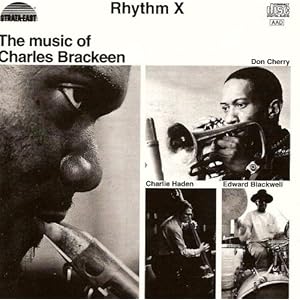
Charles Brackeen - Rhythm X (Strata-East, 1968)

Dress rehearsals for the Loft-era to come. In 1968, Strata East released Rhythm X, in which Charles Brackeen is accompanied by the same musicians that gave fire to the world of jazz with their mentor Ornette Coleman. So, Charlie Haden on bass, Ed Blackwell on drums and Don Cherry on trumpet give shape to a beautiful set that is a good companion to "This is Our Music" and "The Shape of Jazz to Come". Charles Brackeen is another unsung hero, master on both tenor and alto saxophone; born in Oklahoma on March 13, 1940, he moved to California in 1956. Rhythm X is his first album as a leader. In 1973 Brackeen met again Don Cherry for his "Relativity Suite", and in 1975 was part of Leroy Jenkins' first album "For Players Only", including the likes of Anthony Braxton, Dewey Redman, Leo Smith, and Jerome Cooper. The year after he took part of a session with pianist Ahmed Abdullah, part of which was included in the third volume of "Wildflowers: New York Loft Sessions". After a collaboration with David Izenzon and Paul Motian, Charled Brackeen took part of the sessions that lead bassist William Parker to record "Through Acceptance of the Mystery Peace", positioning himself as a bridge between the new and the older generations of creative New York musicians.


Commitment - The Complete Recordings 1981/1983 (No Business Rec., 2010)

Multi-culturalism and multi-ethnics, as part of improving self-consciousness, was part of the program in NY loft scene. This beautiful and important reissue, coupling the 3 CD box "Muntu" dedicated to art and mastery of Jemeel Moondoc, is one of the most important document of the generation of musicians coming after Murray and Aklaaf: bassist William Parker, trumpeter Roy Campbell, reedist Will Connell, Jr, violinist Jason Kao Hwang and drummer Zen Matsuura. Both re-issued by Lithuanian label No Business Records, those two CDs show a music in which timbre, sound, nuances and shades are as important as the attempt to synthesize different musical experiences in an almost meditative, but dense, setting. Ethnic and stylistic references are now melt together in a different way that the previous generations of loft musicians did: so, this music is quite similar to the first proper avant-garde generation, the one under the AACM umbrella, but the blending and the layering of the many faces of music is more homogenous, less rough and extreme. Probably Bill Dixon lesson was absorbed in a more effective manner, but maybe it's difficult to point and find out for a single musician and moment in developing such experiences. Try also and listen to the beautiful archival material that Geodesic is currently issuing, with beautiful concerts taken at the Detroit Institute Of Art since 1979 to 1992: the first three volumes, in which people like Leroi Jenkins, Tani Tabbal, Jaribu Shahid and Spencer Barefield are involved, will show you many analogies with this material coming from New York .

Saturday, July 16, 2011

"Even so, the music is yet to come" (Lester Bowie)

Introducing the Loft Era - Pt. 1
Words: Gian Paolo Galasi


Sam Rivers at Studio Rivbea, 1976


One of the great misses in developing a written history of jazz is the so-called 'loft era', and the developing of his heritage through his many rivers. People like Rick Lopez and Ben Young are still making an important effort to organize a solid mass of documents, using the internet and the radio to share a well organized archival storage; but a complete, written, detailed and documented history of that 1972-1986 period is yet to come.

Some aspects of that history have come to the surface, though referred to music beyond avant jazz, thanks to books like "Hold On to Your Dreams: Arthur Russell and the Downtown Music Scene, 1973-92" (Tim Lawrence, Duke University Press, 2009), Arcana: Musicians on Music. (John Zorn, New York: Granary Books, 2000) or Sonora. Itinerari Oltre il Suono (Carla Chiti - Walter Rovere, Materiali Sonori Italia - 1998), published with Italian/English text. But an extended analysis of the loft-jazz related scene has yet to be made. There is a section specifically referred to that issue in Fire Music: a Bibliography of the New Jazz, 1959-1990. (Gray, John; New York: Greenwood Press, 1991) and many information about its roots are detailed in As Serious as Your Life: John Coltrane and Beyond (Valerie Wilmer;  London: Serpent's Tail, 1977). This last couple of books are currently out of print, and available only through public libraries, or through remainders bookstores.

In 1972, " saxophonist Sam Rivers hosted, at his Bond Street loft, a counter-festival to George Wein's mainstream Newport in New York Festival. Shortly afterward, Rivers received funding from the New York State Council on the Arts for an ongoing series of concerts" (Peter Cherches). Before Rivers', there were the Bill Dixon experience called 'The October Revolution in Jazz' in 1964, but the 'loft era' was something different from the attempt to give life and shape to an entire movement out of a single's mind will. In fact, there were more than one subject actively involved, the spaces in which to rehearse, make gigs and record together were related to more than one person, and all of them were working together.

Lester Bowie's Sho Nuff Orchestra
Rivers' was one of the many places in which a musician could rehearse virtually day and night, and also get in contact with his fellows. So there were "Ali's Alley, run by drummer Rashied Ali; pianist John Fischer's Environ, Joe Lee Wilson's The Ladies' Fort, Studio We on Eldridge Street, on the Lower East Side, Warren Smith's Studio WIS and The Brook in Chelsea. Not to mention the Tin Palace, a club at Bowery and 2nd Street, Jazzmania Society, a loft in the East 20s, and La Mama theatre on East 4th." (Gary Giddins)

In the middle, as both Peter Cherches and Gary Giddins ("Riding on a Blue Note: Jazz and American Pop", New York, Oxford University Press, 1981) recall, there were both AACM and BAG experiences, the many records issued by Nessa and Delmark, as long as Henry Threadgill's Air and Leroy Jenkins' Revolutionary Ensemble attempts to share the bill with other media as theater, dance, cinema.

In the loft-era, well up-to-date labels were "Lake’s Passin’ Thru and Bob Cummins’ India Navigation, the Steve Backer-directed Arista Freedom and, most important of all, Italy’s Black Saint/Soul Note, as well as hundreds of labels huddled under the umbrella of New Music Distribution Service, which had grown out of the 1960s Jazz Composers Orchestra Association". (Gary Giddins)

Unluckily, almost all the records are now unavailable. Passin' Thru, the label founded by Oliver  Lake, is still active and working on new material, but none of the old Lps were reissued. Gilles Peterson, BBC Radio 1 broadcaster, talks about some of the labels aforementioned and the records they produced for his "Freedom, Rhythm and Sound", a beautiful collection of covers of the era spanning through Strata East to India Navigation, from Delmark to Impulse!, from Flying Dutchman to BYG/Actuel. Companion of the book, a double CD was published by SoulJazz records, including music by Archie Shepp, Sun Ra, Mtume, Joe McPhee, Phil Corhan, Gary Bartz, and many more. Not all of those artists were in close relationship with NY lofts, but they all come from the same era and their aesthetics and attempts to make new music out of jazz, soul and black consciousness is very similar.

Henry Threadgill

In "Wildflowers: Loft Jazz New York 1976", re-issued in 2009 on a 3 CD set, producer Alan Douglas put, originally on 5 LP all published in 1976, an important selection of the sessions that took place in Studio Rivbea. Artists featured are the likes of Kalaparusha Maurice McIntyre, Anthony Davis, Randy Weston, Roscoe Mitchell, Anthony Braxton, Dave Burrell, Ahmed Abdullah, Andrew Cyrille, Jimmy  Lyons, Hamiett Bluiett, Julius Hemphill, and Oliver Lake. Others good records to start with, Sam Rivers' "Crystals" (Impulse!, 1974), in which 64 musicians are playing compositions written between 1959 and 1972. This in fact wasn't the only effort in realizing a complex orchestral work (only Sam Rivers wrote more than 300 scores): think also about Lester Bowie's Sho Nuff Orchestra. Lots of critics point out at Dave Holland's "Conference of the Birds" (ECM, 1973) as the most important of the time.

What does this music sound like? Is the 'loft-music' different from previous and forthcoming free or avant jazz music done or to come? There are common references? According to Gary Giddins, "music was challenging without being ideological. It merged and fused jazz, pop, free improvisation, fastidious and “conductionist” scores (not since the 1950s had so many big bands sprung up) with instruments from around the world, employing swing, funk and rubato rhythms in a music of extraordinary range, seasoned with humor, irony, nostalgia, sarcasm and stubborn independence."

But, as Sam Rivers himself pointed out to Mark Minsker in 2005, "Leroy Jenkins, [Henry] Threadgill and Hamiett Bluiett […] like myself, we were already complete musicians. In the past, that didn't happen. Most of the musicians who came in were like Miles and Wynton - they learned on the job. […] And we were all playing our own music all the time. Not just a concert every once and awhile. That's what started us having concerts on Bond Street - being able to play anytime we wanted." So, more than a stylistic endeavour (that anyway exists and can be filed under 'synthesizing experiences coming from different sides'), the whole scene is marked first and foremost by the need to take control over shows and records and to manage an independent career, experimenting with structures and scores as much as with the gaining of a mastery on their instruments without the need to expatriate, as almost all musicians involved in the scene had previously done in order to have gigs or make recording sessions.

Downbeat, Nov. 1978
Another important effect, in order to understand the future development of experimental music in the famous 'downtown' scene, was well described by Rivers himself on an interview originally issued in 1978 on Downbeat: "there is no avant garde. There is no avant garde in European classical music, and there is no avant garde in jazz. There are modernists and there are traditionalists. […] We have reached a total access to all musical elements. I can't imagine another fundamental change in the music, unless we consider the electronic - and then how can we think of music more as an engineer than musician?".

Modernism is here a key word. To make it better clear, think that the producer of the Wildflower record series was Alan Douglas, who was also Jimi Hendrix mentor. It seems that Rivers and Hendrix had to make a record together, and were scheduled to have a rehearsal. Lots of musicians outside of the jazz community were also playing in lofts in order to reach full creative expression, survive and being accepted in artists' communities, and share their proposals with them.

So, as far as the end of the 1970s is near, the 'loft' scene starts to expand including musicians as Eugene Chadbourne, Arto Lindsay, Ikue Mori, Arthur Russell. A melting between avant jazz, no wave, minimalism and so on. Probably the most complete musicians and composers to come out of this melting pot were John Zorn, Kip Anrahan, and Lawrence D. "Butch" Morris. Postmodern thinking starts to take the place of post-punk and afro-american communities efforts to enlarge musical and ethnic boundaries, reflecting the change that reaganomics imposed definitely on economy and politics in the United States since 1984.

Friday, July 15, 2011

From Francis Bacon to Free Improvisation (and beyond)

Words: Gian Paolo Galasi


Francis Bacon, Three Studies of the Male Back, 1970

I started Gilles Deleuze's "The Logic of Sensation" this winter, and when I read the pages related to the concept of "histeresis", and its application to modern painting - the blurring of the boundaries between object and subject, the use of color as rhythmic pattern - by the French philosopher, I found out that what he put on the table was in fact embracing many of the artistic tides developed since the second half of the 20th century. Deleuze's book is about Francis Bacon's painting, but, as many of the philosophers writings, it tries to be inclusive and to track a sort of 'minor' history of the most vital artistic statements of the time, and back. But, far from what Gilles Deleuze embodies in his text - Francis Bacon, Vincent Van Gogh, Eadweard Muybridge, Diego Velasquez, Paul Cézanne, as long as Samuel Beckett, Franz Kafka and Marcel Proust literary masterpieces -, I was thinking first and foremost about Antonin Artaud - on which Deleuze himsepf came back in many of his essays, from The Logic of Sense to A Thousand Plateaus - and performance arts, from Vito Acconci to Marina Abramovic. And, obviously, to music.


I was listening to Roscoe Mitchell's No Side Effect (RogueArt, 2006) in those days. So in a certain way improvised music (Albert Ayler, the AACM) was implied in surrounding the impressions Deleuze's book gave me, but, in my effort to articulate a more extended analysis, I have to imply also Demetrio Stratos' and Sainkho Namtchylak's studies on voice, that are related to some techniques many post-bop horn players developed, starting with John Coltrane. Maybe the proper field for this study would probably be European contemporary music, with Iannis Xenakis and Karlheinz Stockhausen as examples of what was then called 'post-serialism', and the so-called 'Industrial music' - this definition in Europe doesn't include music related to heavy metal, but forms of music developed first as accompaniment for performances, and then risen to a proper authonomy with Throbbing Gristle, Einsturzende Neubauten and Maurizio Bianchi -, and the Sound Art, as a matter of how the sound can influence the perception of the space. 


In this article I want to give some tools that can be useful for a first approach with a discussion on how the French philosopher's essay fits with music, and to what extent, skimming through genres and styles. Deleuze was very influent in the 1960s here in Europe and then in South America, where he still is. David Toop in his Ocean of Sound talks diffusely about Deleuze's concept of 'rhizome' - a root without a proper original branch, metaphor for a way of thinking without relating reality to a unique and univocal meaning - as a strategy to reach a 'nomadic' way - a way not based on given, i.e. 'sedentary', structure of language, of signifying - to approach creation; that's what Sun Ra's and other jazzmen were doing: issuing their own records on their own labels, and so avoiding artistic compromises, and then giving some of their artefacts to some major or independent labels. That's what the avant-garde pianist did, as an example, with Space is the place, issued on Impulse!, or with Nuclear War, published on Mark Stewart's On-U Sound.

Francis Bacon Study for the Head of George Dyer
Hysteresis, so. It's difficult to undesrtand it correctly if you are not aware of some cornerstones of the structuralism. In particular it would be interesting to focus on Jacques Lacan's seminars about psychoanalisis and the concept of 'hysteria', that he, as structuralist, considers as the refusal to apply the language of Power to the body, as the proper feeling of the hysteric subject. And this, because power refuses to give desire his proper place in the world of language and in the word of the Law. As far as desire, for Lacan, "desire is neither the appetite for satisfaction nor the demand for love, but the difference that results from the subtraction of the first from the second." Lacan adds that "desire begins to take shape in the margin in which demand becomes separated from need." So desire can never be satisfied, as Slavoj Žižek says: "desire's raison d'être is not to realize its goal, to find full satisfaction, but to reproduce itself as desire."

A good part of the Deleuze's thinking is based on the opposition between power and desire. The concept of power is taken from Hegel and seen as something - the dialectics - that comes from, and produces, dissociation - thesis versus antithesis. "Petrolio", a novel by Pier Paolo Pasolini, or his Salò movie, are good literary translations of that concept. Desire is all that remains when the structures of the speech as a form of power on reality - the presumption to give order to reality with words - collapse. Again, Pasolini's 'Teorema' is a good picture of that idea. At the center of the paintings of Bacon there is a work of removal, an ethic work that leads precisely to abandon power for desire. Bacon take away the figure, the shape and the filling is blurring, so there are no more specified subjects - man and animal, subject and object, figure and environment, and so on.


And again, movement in Bacon is always double, systolic and diastolic at the same time. An abject athleticism - from latin 'ab-jectus', something that remains beyond the sub-jectus, which is the subject - leading from the figurative pattern that imprisons the figure into being only in this movement - the sink, the mirror - and filled to the figure - the body as Plexus / spasm, hysterical scene: escape through any body prostheses: syringes, umbrellas, mouth / scream ... -. Extraction and isolation, as opposed to the intelligible narrative relations of classical figurativeness. The butchered meat, the zone of indiscernibility between man and animal. The bones will rise from the flesh, as the flesh descended from the bones. Acrobatics of the flesh, an extension of athletics in the body. Face, head, cry escapes the body through the mouth, like blood from a severed artery. Spiritual movement.

Place created by those forms of art is similar to the anthropologist Victor Turner concept of 'liminarity' in his 'Rite of passage', and a good picture of it can be considered the way a Tibetan singer uses his throat in order to produce a double sound, positioning his tounge and glottis as if he is passing from 'l' letter to 'm' letter. This is a 'middle' position, but one that produces a double sound. Hysteresis, so, is the 'rhythmic' eye. The eye becomes ear: it feels time, as does the ear when you listen to music. And so becomes 'schizophrenic', says Deleuze, but not in the usual sense of dissociation. Schizophrenia as music is, because music disembodied bodies, the place (not the concept) of vanishing lines that cross the bodies themselves, but that are consistent elsewhere, hysterized through the introduction of color. How can we not recognize in that description the timbre, old fetish of improvisers, but also the use of a certain layering of sound even in analog and digital electronics, or in some contemporary composers, as in Karlheinz Stockhausen or Iannis Xenakis? How about electronic music, be it Miles Davis electrified trumpet, or the first contemporary composers in producing music through ring modulators?

The body draws on its new organs, like Antonin Artaud had predicted in 'Pour en finir avec le jujement de dieu'. It's a metaphor for multiculturalism, in the sense of the crossing of two different cultures, that usually produces something completely new: the 'african-american' music isn't a mere adding of two cultural forms of art: it is a totally new music. The 'hysterized eye' ceases to perceive the figures arranged in space according to a scan or narrative perspective, and through the articulation of three elements - material structure / set position / area and contour as the unfocused limit of both - creates a structure of rhythm / feeling. The body is thus the zone of indiscernibility between subject and object, between sentient and heard. Pure affection. The feeling acts as an agent deformating the body, and creates a gap in which it is organized through a sequence, a spasmic passage from a level to the other. 


So let's go back to music, to the rhythm given through the use of color. It's something similar to the dyplophonies used in Tibetan singing, or to the resonances of certain Arab, Middle or Eastern instruments - qanun, sitar -. But the same is with the way a musician like Roscoe Mitchell sometimes uses triplophonies on his horns. Same with Coltrane and Pharoah Sanders, their use of tritones: they aren't a mere addition of a sound to another, but a new form of vibration. And the same is with the bass lines Henry Grimes give shape as a matter of texturizing different colors, different layers of sound.

Surely, if we think about avant garde jazz, its roots aren't in Western philosophy, but in a practice that is more confident with other concepts, like sound as vibration, as an example. Quoting Sufism and his mysticism can be a better idea. But since the 19th Century European thinkers - e.g. Schopenhauer or Nietzsche were both enthousiasts readers of the Bhagavad Gita- were looking at the Eastern World as a new model, less related to the division between reason - the self-consciousness as the result of the ego seeing himself - and the irrational - all that can't be explained with scientific measures. Psychology and anthropology - Carl G. Jung ideas on Symbols and Collective Unconscious, as Victor Turner idea of Experience - are more related to an Olistic approach to the human mind than Freud's idea of the Ego and Hegel's concept of dialectics. A more fluid approach to things, and a reflection of that knowledge parameters change can be seen in Antonin Artaud's 'The theater and its double', or in Jerzy Grotowski's Toward a poor theater; the same is with Francis Bacon and, to some extent, Jackson Pollock's paintings, and music after the middle of the last century. 


Tuesday, June 28, 2011

A music heritage: Mario Schiano

Hyperfragmentation of today's music business sometimes doesn't help that much, if you want to give the right value to people, movements, or even moments in the history of a particular style. In 2003, manifestolibri published a little but important book (138 pp. only) titled "Un cielo di stelle - parole e musicadi Mario Schiano". His author, Pierpaolo Faggiano, is a journalist, that writes also for the italian All About Jazz site. The book, conceived as a long interview with Italian saxophonist Mario Schiano, is accompanied by the CD "Apollon - Una fabbrica occupata". Recorded in 1968 by Schiano himself with bassist Marcello Melis and drummer Marco Cristofolini, the music, never available before in its entirety, is the soundtrack for Ugo Gregoretti's movie with the same title.

Apollon was in fact a typography placed in Rome. In 1968 employees took it up for one entire year; Gregoretti made a documentary with squatting images, and superimposed the voice of actor Gian Maria Volonté (a famous icon of Italian social consciousness and political commitment through artistic expression) as a narrator. Some fragments of the music from this records were put throughout the scenes, but they were in fact very short pieces: in fact, the record was issued with this book for the very first time. It's really a pity that this book and CD were no longer reissued after their first press, but they are actually easily available through the publishing house or in Italian reminders bookstore.

One of the pivotal figure in the development of free improvisation in Italy, Mario Schiano, born in 1933 in Naples, crossed his career with the likes of Marcello Melis, Bruno Tommaso, Giancarlo Schiaffini, Giorgio Gaslini in Italy, and with internationally recognized artists such as Joelle Léandre, Fred Van Hove, Paul Lovens, Han Bennink, Misha Mengelberg, Mark Dresser, Dave Holland, and Sam Rivers. He started playing with his Gruppo Romano Free Jazz in 1966 in Rome, after shorts and criticized experiences in his homeland. The trio was Schiano on alto, bassist Marcello Melis and drummer Franco Pecori. In those years Rome was the base for internationally acclaimed musicians like Gato Barbieri, Don Cherry, and Steve Lacy.

Gruppo Romano Free Jazz, Folkstudio, Roma 1967 - Photo: Pierpaolo Faggiano 

"Apollon" is only a small, but highly interesting, part of that reciprocal involvement between musicians, movie directors, writers, intellectuals, with the politics of that time and creativity in an attempt to suggest a more open and deeper look on what was going on in society and in the world. Marcello Melis, just to name another important collaboration of this period, was involved in Pier Paolo Pasolini's movie "Appunti per un'orestiade africana". For the soundtrack, he worked on Sardinian ethnic traditions, mixing them with African-American music, as he did also in his "Perdas de fogu" (RCA, 1975, featuring Don Pullen on piano, Sheila Jordan on voice, Bruce Johnson on guitar and Jerome Cooper on drums) and "The new village on the left" (Black Saint, 1977, with Roswell Rudd on trombone and Enrico Rava on trumpet) records. That was the environment, with musicians merging different levels and shapes of both innovation and tradition.

Schiano himself was heavily involved in mixing free improvisation with various ethnic forms of music, often misunderstood by producers, but nonetheless keeping on pushing his creativity. Further, after the hot season of political and social protests was drowned under terrorism and international conspiracies, fermented in order to put Leftists apart from Italian government, Mario Schiano won't give up. He worked hard on experimental music: a solo saxophone record produced by Gianni Sassi (that in those days was trying to disclose to a large audience John Cage's aesthetics and Demetrio Stratos' experimentations on voice diplophonies along with Nanni Balestrini post-Gruppo '63 writings, just to name his most famous attempts in disclosing avant-garde to a most popular and young audience), and a series of attempts to mix creative jazz and cabaret structures, with a notable record such as "Un cielo di stelle" (Cramps, 1979, co-titled with Tommaso Vittorini)

The heritage of Mario Schiano is now shared and preserved between his closest collaborators. The most important is the experience of the Italian Instabile Orchestra, in which he played for many years, spanning through a career culminating in a record with pianist Cecil Taylor ("The owner of the river bank", Enja, 2003), that gave the orchestra one of his typically short, but relevant, appreciation: "The Instabile can play". The book is closed by three short writings composed between 1979 and 1982. Three ironic portraits of the environment of the time, and of the world and attitude related to the music business. I personally hope not only for a new reissue of the book, but also for an English translation of it. In the meantime, for all who wants to enjoy the music, at the addresses mentioned in this article the book+CD is all still available, and for a very cheap price.

Related Links:
Pierpaolo Faggiano at AllAboutJazz Italy


 Italian movie director Ugo Gregoretti
talks about the making of "Apollon"

Friday, June 17, 2011

A shamanic workshop: Sainkho Namtchylak Feat. Arto Lindsay

Music Workshop 2011
Milano, May 31, 2011
Triennale di Milano, Teatro dell'Arte

Words + Photos: Gian Paolo Galasi


Even if you're not cynic, it's nevertheless difficult to pull apart how you have to be tough if you want to strive your goals in the music business today, and try to share your own personal achievements with a large audience. While tonight two veterans of experimental languages like Sainkho Namtchylak and Arto Lindsay are playing in an almost full theater near the center of the city, in a quiet and cool place like the Triennale Museum and its surrounding and almost natural environment, lots of musicians are harshly strieving for places to play in and people to play with. Those last six months were demanding for experimental music (and beyond) hard-ons. Milano will surely be a better place in September, when the MITO Festival will bring us a series of events related to Haiti music and culture, and the likes of Diamanda Galàs, Louaka Kanza, Omar Souleiman, Christian Fennesz.

But since January, people here had the possibility to see only a bunch of important happenings: bassist Joelle Léandre playing with poet and performer Nanni Balestrini, Peter Brotzmann accompanied by Steve Lacy's devotee and fellow Gianni Mimmo, with friends Xabier Iriondo on guitar and self- built instruments and Cristiano Calcagnile on drums, plus the Organic project led by trumpeter Wadada Leo Smith, veteran of the AACM Association. Only the last one was promoted by a theater, being the others settled in a couple of self-administered social structures, Cox 18 and Torchiera. As far as going 'underground', a good mention is for Attila Favarelli, a musician that since the beginning of this month is organizing in The Lift, his private recording studio, public exhibitions of young French composer Kassel Jaeger and Echtzeitmusik's duo Mat Pogo/Ignaz Schick, and for O' - Artoteca, a place devoted to both installation/performances/contemporary art and electronic music.

Far away from matters related to scheduling, on 31 May at La Triennale di Milano, Sainkho Namtchylak and Arto Lindsay shared with the audience the result of a two-day workshop in which they gave shape to an amazing mix of tuva/tibetan deep throath singing, lullabies and no-wave slights, or, better said, clouds of coal and sound. It's impossible not to recognize the distinctiveness of this couple of prime movers in their own fields, and breathing the result of two creators of musical nuances working together is always a wave of freshness in the middle of that part of today's cultural scenery that fixed quest and personality as the most important values.

Two different sets: a solo performance by Namtchylak, that you can see as a good introduction to her last output Cyberia, a record related to oytulaask chants and shamanic experience that takes the stock of the singer's multi-faceted vocal technique, spanning from open melody through improvised singing; and the duo with Lindsay's nervous but well balanced mix of rapid slashes and distorted and surrounding effetcs. If the firts part of the concert is remarkable because you won't find elsewhere a singer able to combine multi-tones chant with the wide spectrum range she's gifted, the second part is the real surprise. Guitar plunges vocal textures, opening then to lead us into a dark, misty and surrounding environment.

And even if Lindsay and Namtchylak together were playing what seemed to be a bunch of eccentric, vaguely melancholic and noisy ballads, the twos showed a coherence of inspiration and of result. Lindsay accompanied with nervous but fluid movements his playing, while Namtchylak mastery with more structured song forms, combined with her ability to improvise, gave her the possibility to weave a texture around which her partner worked more with his characteristic sound dynamics, from minimal gestures to loud fillings.

It's a matter of fact that music is also a playing field in which moods and colors loose the tracks we usually relate to common and everyday feelings and sensations just to elevate themselves, and you as a listener, to a wider range of emotions and suggestions. This is a big part of shamanic cultures, not that apart from their most direct social function: broadening the stream, opening to a meditative emotional setting in which the number and the value of hues and shades increase and overtake the boundaries of directness, just to take time and place in which to experience a much open perspective. That's what people in the audience tonight took part of, and this is a good reason to push forward with that and all related musical occurrences.

See Also:
Arto Lindsay official website
Sainkho Namtchylak official website


Tuesday, June 7, 2011

Precious Soul: Charles Gayle

Solo Saxophone
Novara Jazz, Cascina Picchetti, 12.00 a.m.
Solo Piano
Conservatorio Cantelli, Novara, 20.00 p.m.
June 2, 2011

Words + Photos: Gian Paolo Galasi


Charles Gayle,Cascina Picchetti,Novara Jazz
Charles Gayle, Cascina Picchetti, June 2, 2011

This year's edition of Novara Jazz will stand up for a couple of remarkable highlights: Ebo Taylor, who played in Piazza Duomo on May 27 with his Afrobeat hot-flavored call-up, and a couple of exhibitions, in the same day, by Charles Gayle. New York based saxophone and piano player is truly achieving Coltrane's and Ayler's legacy, both on a stylistic and personal level. Gayle is part of a post-bop world that, even before the so-called new thing started harassing the scene as a demanding music-to-listen-to right in the middle of the '60s, waving on his flags statements like Spiritual Unity, wasn't completely feeling at ease with tricky chord changes and bebop jumping out of diminished 7th, even if that was, at the time, the most fashionable way to express yourself. 

In fact, while jazzmen, after Parker and Gillespie more orthodox followers, tried to warm and cool music with always excellent but as different results, as the likes of Miles Davis, George Russell, Oliver Nelson, there was an unprecedented and parallel world of, mostly, unsung heroes, that were trying to go back to their gospel and church roots. Charles Gayle, as his more succesfull, posthumously speaking, fellow Albert Ayler, drew heavily on chants and prayers. Picking up a record like Forgiveness (Not Two, 2008), and skimming through the titles, like 'Living Waters', 'Glory, Glory, Glory', 'Forgiveness', makes widely noticeable their being coherently in line with 'The Bells', 'Holy, Holy, Holy', 'Initiation'. 

Surprisingly enough, Gayle's voice on alto is very related to Ayler's. But while the latter's phrasing was shakey, nervous, confrontational, the former's more gentle, chubby, and in some way more devoted to the way another tenor master, John Coltrane, was usually binding together his statements, at least in a period of his career: starting a line, developing, then coming back to a previous point and going ahead again from that. More spacey, less torrential. Check out his version of 'Giant Steps' to feel what coming from a demanding development of a coherent tought back to his straight essence would mean.


Photobucket
Charles Gayle, Conservatorio Cantelli, Novara, June 2, 2011


Being an open space the ideal venue for a solo alto saxophone or not, Gayle's set was warm, confidential, friendly. The night, in Novara's Academy of Music, a gorgeously fixed old Steinway embellished with full and rich resonances his curling, striding, deep, dissonant, but utterly melodic playing. Whereas he so often layered the bottom to the peak, using even his full arm on the keyboard, or chuckling gently his fingers, the lightness of his touch in both those gestures and in all the possible ranges in between remains a constant, and maybe Gayle's proper, excited but jaunty and bright signature. 

Clusters and melodies are both interspersed the one with the other, bulding up a language that openly moves from jazz tradition but that evolves in a personal statement in which what can seems apparently fuzzy is, in fact, a grooving, hazy network of cross-references, from Thelonious Monk to Art Tatum, from James P. Johnson to Cecil Taylor. Charles Gayle lived for many years following his highly personal options, and as a result he is truly suitable for speaking not only for himself but for a rich and full tradition of inside track shapers.

See Also:
My photo galleries [on alto] [on piano]
Howard Mandel interview to Charles Gayle on The Wire
James Lindbloom interview to Charles Gayle on Perfect Sound Forever