
The 'Loft Season' - Pt. 2: A sampled discography
Words: Gian Paolo Galasi
 |
| Shut up and listen: Lawrence D. 'Butch' Morris |
A complete discography for the entire period related to the "Loft Era" and the "Downtown Music Scene" is probably still impossible to draw, since almost all the Lps issued from 1972 to 1986 are basically out of print. Four of the links at the end of the 3rd part of this series of articles are related to the major labels of those years, but the number of labels that issued records at that time is surely larger. While I'm writing I'm still not aware of any complete attempt to compile a full catalogue; I strongly doubt it, but readers who know more are encouraged to email me. I'm attending to do more researches on the subject, hereinafter.
Pheeroan Aklaff - House of the Spirit: "Mirth" (Passing Thru, 1979)

"Pheeroan Aklaff believes that the arts are a way to give thanks and to work for change". Born in 1955 in Detroit, then active as a drummer also in Ann Harbor, Michigan, and New Haven, Connecticut, Pheeroan Aklaaf debuted on record with Bill Barron in 1975, then he was in Wadada Leo Smith's New Dalta Akri. Long time rhythmic conspirator with the AACM trumpet player (and still active in his Organic band), with Oliver Lake and with Henry Threadgill since his New Air records on Black Saint, Pheeroan travelled to Lagos (where he met Fela Kuti), Abidjan, Cote D'Ivoire and India. "House of the Spirit: 'Mirth'" was released in 1980, and is a solo drum record. As for almost all the music produced during the Loft Era, in comparison to previous efforts (a good example being Milford Graves' "Percussion Ensemble" on Esp Records), Aklaaf's approach to music is more 'straight', less abstract, 'back to roots' of funky, soul and gospel music; even the many influences from African, Brazilian and Eastern rhythms are easily recognizable by a non-musician. The same with the gospel that informs a track like 'Freedom'. '3 in 1', the composition closing the album, was issued on SoulJazz's compilation "Revolution, rhythm and sound" two years ago. According to the AllMusic Guide, this record has been reissued this year by Universal Sound, but on the official site of the label there is nothing about the subject.
Mbari (Julius Hemphill) - "Dogon A.D." (Arista Freedom, 1972)

Many times, writing about the difference between experimental and popular music doesn't pay the bill, and Julius Hemphill's music is just the case, syncretistic as much as underrated and unrecognized. His disciples are as diverse horn players as David Sanborn and Tim Berne (who reissued for his Screwgun label the remarkable Blue Boye). In an online interview, Berne explains how Hemphill music was reconciling r&b with avant-garde. Born in Forth Worth, Texas - also Ornette Coleman hometown - in 1938, deeply influenced by gospel and rhythm&blues, due to his local roots, and jazz, via Charlie Parker, Lee Konitz and Cannonbal Adderley, in 1968 Hemphill moved to St. Louis, Missouri, where he joined the Black Artists Group, an association very similar to the Chicago's AACM. After playing with Anthony Braxton in several saxophone-only ensembles, Hemphill founded the World Saxophone Quartet with David Murray, Oliver Lake and Hamiett Bluiett. "Dogon A.D." was released on Freedom in 1972, with trumpeter Baikida Carroll, cellist Abdul Wadud, and drummer Philip Wilson. You can take this record as an answer to the Art Ensemble of Chicago's famous "Les Stances à Sophie", but by itself is one of the early, and most accomplished examples of what the direction of the music would have been for the next 15 years in New York's avant-jazz environment. "Live In New York", a beautiful cello and saxophone duo record by Julius Hemphill and Abdul Wadud, recorded in 1976 in NYC, is another record worth to be mentioned.
David Murray - Synthesis Sentiments (Ra Records, 1979)

Differently from his WSQ classmate Hemphill, saxophonist David Murray is still active and widely recognized by the jazz community. In this record there is also saxophonist Arthur Blythe, trumpeter Olu Dara and percussionist Rashaan. But it's Flower for Albert, an homage to Ayler's mastery, to make deeply understand the ideal lineage of that music. Born in 1955 in Oakland, California, and awarded with such honours as a Guggenheim Fellowship, a Grammy Award, and named musician of the decade in 1980 by the Village Voice, like his fellow Hemphill David Murray refused to be over-influenced by John Coltrane, developing, instead, a language that is more reminiscent of Coleman Hawkins, Ben Webster and Paul Gonsalves. Master in circular breathing, his voice on tenor is very related to human voice, warm and mellow even when dissonant and churny. David Murray has recorded or performed with musicians such as Henry Threadgill, James Blood Ulmer, Olu Dara, Tani Tabbal, 'Butch' Morris, McCoy Tyner, Elvin Jones, Ed Blackwell, Johnny Dyani, and Steve McCall.
Charles Brackeen - Rhythm X (Strata-East, 1968)
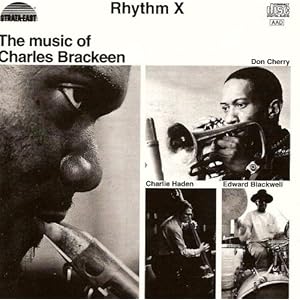
Dress rehearsals for the Loft-era to come. In 1968, Strata East released Rhythm X, in which Charles Brackeen is accompanied by the same musicians that gave fire to the world of jazz with their mentor Ornette Coleman. So, Charlie Haden on bass, Ed Blackwell on drums and Don Cherry on trumpet give shape to a beautiful set that is a good companion to "This is Our Music" and "The Shape of Jazz to Come". Charles Brackeen is another unsung hero, master on both tenor and alto saxophone; born in Oklahoma on March 13, 1940, he moved to California in 1956. Rhythm X is his first album as a leader. In 1973 Brackeen met again Don Cherry for his "Relativity Suite", and in 1975 was part of Leroy Jenkins' first album "For Players Only", including the likes of Anthony Braxton, Dewey Redman, Leo Smith, and Jerome Cooper. The year after he took part of a session with pianist Ahmed Abdullah, part of which was included in the third volume of "Wildflowers: New York Loft Sessions". After a collaboration with David Izenzon and Paul Motian, Charled Brackeen took part of the sessions that lead bassist William Parker to record "Through Acceptance of the Mystery Peace", positioning himself as a bridge between the new and the older generations of creative New York musicians.
Commitment - The Complete Recordings 1981/1983 (No Business Rec., 2010)

Multi-culturalism and multi-ethnics, as part of improving self-consciousness, was part of the program in NY loft scene. This beautiful and important reissue, coupling the 3 CD box "Muntu" dedicated to art and mastery of Jemeel Moondoc, is one of the most important document of the generation of musicians coming after Murray and Aklaaf: bassist William Parker, trumpeter Roy Campbell, reedist Will Connell, Jr, violinist Jason Kao Hwang and drummer Zen Matsuura. Both re-issued by Lithuanian label No Business Records, those two CDs show a music in which timbre, sound, nuances and shades are as important as the attempt to synthesize different musical experiences in an almost meditative, but dense, setting. Ethnic and stylistic references are now melt together in a different way that the previous generations of loft musicians did: so, this music is quite similar to the first proper avant-garde generation, the one under the AACM umbrella, but the blending and the layering of the many faces of music is more homogenous, less rough and extreme. Probably Bill Dixon lesson was absorbed in a more effective manner, but maybe it's difficult to point and find out for a single musician and moment in developing such experiences. Try also and listen to the beautiful archival material that Geodesic is currently issuing, with beautiful concerts taken at the Detroit Institute Of Art since 1979 to 1992: the first three volumes, in which people like Leroi Jenkins, Tani Tabbal, Jaribu Shahid and Spencer Barefield are involved, will show you many analogies with this material coming from New York .


