First time I heard of Daniele D'Agaro,
it was in 2011. I came across a couple of records by HatOLOGY,
Strandjutters and Chicago Overtones, into a record shop. I haven't
bought those albums, nor tried to download some of his music. At that
time, I was listening to a lot of contemporary stuff sent to me from
around the world, mostly Turkey, plus a lot of reissues, to give me
some background in order to judge properly the newest material, to
know the roots of this music. But I was very curious about this
clarinet player, so now that I had the opportunity to listen to his
newest creation, this trio documented through the album Tea Time
issued by label Rudi Records, it is the right time to deepen his
figure and music.
D'Agaro, clarinet player, started his
activity in 1979 and he moved to Berlin for a couple of years. In
1983 he moved again to Amsterdam where he started collaborating with
some of the most representative names in the field of improvisation
as Benny Bailey, Misha Mengelberg and Louis Moholo-Moholo. In 1989 he
gave life to a trio with Tristan Honsinger and Ernst Glerum, creating
a style of improvised music bathed in Kwela music (South Africa) and
folk; from that period on his interest in different styles of music
flourished, incorporating folk music from Friuli and gregorian chant.
D'Agaro is not an enemy of contemporaneity, as his collaboration with
Richard Teitelbaum testifies.
I've written diffusely of flutist
Massimo De Mattia in this post.
As far as the third member of this trio, double bassist Giovanni
Maier, he is well known here in Italy for his projects related to his
instrument, documented in a series of beautiful records for bass
solo. In 1996 he worked with Butch Morris for the Conduction n° 61
in Berlin, and between the other musicians he collaborated with there
are Cecil Taylor, Anthony Braxton, Roswell Rudd, Han Bennink, Tim
Berne, Ernst Reijseger.
How's the music on this record? It is
music fully integrated in the history of improvised music. Long
flows, abruptly interruptions, triple chords, silence, all the
rethoric elements of improvisation are here present to be enjoyed
by the fans of this style of music. I love it. Anyway, there's no
progress. This album is symptomatic of a more general situation in
the world of improvised music nowadays. Many new musicians are trying
to develop their own style, more or less disengaged from the blue
notes and the mood of african-american music as it happens from the
1970s, but sometimes the music is poorer than the one developed by
the likes of Evan Parker or Peter Brotzmann.
On the other hand, you have a bunch of
musicians, as the ones featured in this record, who master just fine
their own art, and who fit perfectly in the history of improvised
music. The fact that they aren't renovating it, creating NEW music,
is not their own fault. We lack, I believe, a new vision of the
world, a new vision of society, as musicians as Anthony Braxton or
Don Cherry had in the past. This lack is part of our heritage, it is
the real problem. Music comes after. But for the moment, I invite you
to enjoy this music as brilliant as it is.
Music is born free. Its path is a return to freedom - Edgard Varèse
Sometimes you meet music able to lead you through the path you're still covering towards unexpected regions; sometimes, giving you hints for your further explorations. That's what happened to me when I first ran into the music of Massimo De Mattia and Zlatko Kaucic.
My first listening occurred last year, when the Italian webzine Mescalina gave me a record issued by label Setola di Maiale dedicated to Pier Paolo Pasolini, George Bataille and Jean Genet. Unusual territories for an improviser, but well known to me through my exploration of literature, theatre and performance art.
Though I never saw live De Mattia and Kaucic, I retrieved Kaucic Tolminski Punt, more or less in the same period I was interviewing Peter Brotzmann, present on the record as a guest. Even when I was in London, Massimo de Mattia was sending his new works to me via mail, and thanks to his collaborations I ran into the music of Lanfranco Malaguti.
After reviewing Panorami for my alter blog london_resonance, I had some short but interesting dealing with the guitarist, and both his highly personal compositional methods and his opinion on Derek Bailey and other topics became an interesting balance to what I was listening in UK's capital in those days.
That's the reason I want to start a little introduction to recent releases of two musicians that, from their own regional borders, are still diffusing some of the most intriguing compositions and sounds you'll find traveling trough Italy.
Massimo De Mattia is born in Pordenone, on 1959. Self taught flutist and composer, he started his activity in the 1970s with Lanfranco Malaguti, Bruno Cesselli, U.T. Ghandi, Gianluigi Trovesi and Ares Tavolazzi. His debut as a leader is 1993 with the record Poésie Pour Pasolini.
In his most recent years artistic director of the review Schermosonoro and founder of Zerorchestra in his homeland, De Mattia explored through music important figures of XXth Century culture as painter Egon Schiele and actor, poet, theatre writer and theorist Antonin Artaud with younger pianist and composer Giorgio Pacorig.
With great sensitivity, and with more than 20 records only under his own name, Massimo De Mattia during his career developed and showed a personal approach to both timbre and composition comparable to the most important European and worldwide recognized musicians of his generation. His approach to literature, poetry and painting melt different, often synesthetic suggestions into a coherent canavas through nervous and oblique flows of energies, charms and balances.
Zlatko Kaucic, born in Postumia (now Slovenia, then Jugoslavia) is an accomplished drummer, percussionist, composer. In his career Kaucic toured intensely through Europe - mostly Swiss, Spain, Holland, playing with improvisers like Irene Schweizer, Tete Montoliu, Kenny Wheeler, Steve Lacy, John Lewis, Louis Moholo Moholo.
Kaucic music is the result of his journeys through different styles - his first listenings to prog rock as P.F.M., Van Der Graaf, Genesis, the Blue Notes' south african free jazz, Max Roach and Billy Higgins and his direct experience through contemporary dance, bossa nova, radical improvisation.
When Kaucic went back in Slovenia, he finally turned on to his roots, adding stories and folklore from his own country to his improvising tips, in order to give life to expressionistic constructions. He started also to teach music and increase his experiences through new collaborations - Mauro Negri, Gianluigi Trovesi, Javier Girotto.
Zlatko Kaucic - Tolminski Punt (Splasc(H), 2007)
Taking inspiration from a rebellion ended in repression in the village of Tomlin in 1713 for excessive taxation on meat and wine, this work in seven movements for violin (Rahela Grasselli), cellos (Barbara Zorz, Eva Julija Recnik), drums (Zlatko Kaucic) and horns (Peter Brotzmann on tenor, clarinet, tarogato) is composed by a first, immaginific string dialogue mixing folkloristic atmospheres and contemporary glissandos and shiftings, counterpointed by flurries of pointillistic and concrete drawings of percussions. After the first four movement, the fifth sees Kaucic and Brotzmann involved on a 40 minutes dialogue full of tension, rage, climaxes chiseled with a clear and almost telepathic attention to the details. Not only than another occasion to measure Brotzmann - and his partner - ability to channel energy into a clear cut and intense dialogue, this second part of the record gives also life to a real narration way ahead every common cliché of free improvising.
Massimo De Mattia - Atto di Dolore (Setola di Maiale, 2011)
The sound of Eros, a vision belongin to French philosopher Georges Bataille, but also to writer and Black Panther activist Jean Genet, and to Italian poet and director Pier Paolo Pasolini, is the point of departure for a record full of concrete, subtle, almost metaphysic energy. P P P, an accompaniment to Pasolini's La Ricotta, is texturized by De Mattia's flute, full of vibratile and ancestral tension, and Denis Biason's subtly spectral guitar. Both are conjuring to take off and tidy expressive coordinates and shapes beyond linear codification, while Bruno Cesselli on piano and Zlatko Kaucic on drums, as in Hot God, are finally chasing the matter while capturing the fine river built by the two fellows - there is also a duo release by De Mattia and Biasson on the same label. Every note is amplified by another instrument, while most of the times pauses have the value of a heal up. The zenith of those dynamics are in Mater, to Susanna Pasolini, where eardrums and strings are responsible for the opening of a meditative space where the flute draw a disquieting flux.
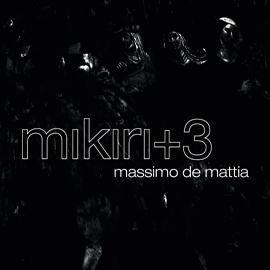
Massimo de Mattia - Mikiri + 3 (Setola di Maiale, 2011)
The quartet of the previous record is here added with Luca Grizzo (voice, percussion) and Romano Tedesco (accordeon). Resulting are seven original compositions plus two oblique and subtly nervous renditions of Jimi Hendrix Who Knows and Thelonious Monk Pannonica. The dynamics involved here are wider, due also to a direct use of piano lyrical possibilities. But if the opener Senci is melancholically straight, giving an essay on the players command on nuances and subtleties, Mikiri ('Cut with the look') is a composition that, with his resolute manner and dense sound, remember the attitude of the Cecil Taylor/Bill Dixon bands without being a stylistic camouflage. Through the tracks, the listener is being constantly urged to enter in a music whose quality, more than a pure addition of density, is a complex, evocative interlacing of different colors, moods and shades. A ballad like Ave Maria shows how a folkloric tune can become a spiritual composition through subtraction, more than abstraction from the form. An interesting, not common hint on how to relate to the dynamics of sound beyond the dialectics of idiomatic and non idiomatic.
Massimo De Mattia - Giovanni Maier - Zlatko Kaucic
The Jazz Hram Suite (Palomar, 2011)
Double bassist Giovanni Maier is an old time collaborator with De Mattia and Kaucic, at least since 1993's Poésie pour Pasolini. Graduated in 1988 at "G. Tartini" conservatory in Trieste, he is developing a project for solo bass since 1994 through different releases. Active collaborator of Roscoe Mitchell, Butch Morris, Tiziano Tononi, Cecil Taylor, Anthony Braxton, Tim Berne, in this trio record, issued for his label Palomar, Maier shows a great affinity with his partners in creating on a live performance a music that lives on different levels. Possibly the less immediate of the group of record here reviewed, at a first listening the five movements of The Jazz Hram Suite can seem the most dry, sober, concise statement provided by its players but, after some close encounter, it can reveal a fascinating and capturing world of nuances and coexisting plans. A highly adviced experience.