
Words + Photos (except the first): Gian Paolo Galasi

This short essay is a first reconnaissance on some interesting points I became aware of in developing my knowledges on improvised music. While I'm planning to develop more with time, I want to start from a couple of books I discussed with their author last year through a brief email exchange.
I'm trying to put down more than a simple 'review' of this works, while at the same time I'm trying to further develop some skills and knowledges whose importance is growing the more I listen to music and I get in touch with musicians.
While discussing about the subject with Davide Sparti, he was also telling me that during this year, 2012, the Oxford University Press would issue wide portions of his writings in English. I hope so to thank him for his availability and his advices, and for some of his writings on Michel Foucault he gifted me with.
If improvised and avant garde music are becoming objects of academic studies, this can probably mean that one of their cycle is closing, or still come to an end, leaving space to new developments in the future. I tried to discuss some of the thesis included in the last couple of books by Italian Associate Professor in Literature and Philosophy at the University of Pisa Davide Sparti, with some improvisers coming from different parts of Europe to play in Italy, or known through my trips in Europe, last year.
Davide Sparti started publishing his studies on the relationships between identity, conscience, recognizement and their ethics - a study coming out of his previous works on Ludwig Wittengstein, Annah Arendt and Michel Foucault - and music as a product and a producer of changes in the experience of the musicians in those fields, in 2005.

Suoni inauditi. L'improvvisazione nel jazz e nella vita quotidiana (in English: Unheard sounds. Improvising in jazz and everyday life) is a serious and well developed attempt on saying something interesting on jazz starting not from musicology but from sociology and philosophy of language, avoiding to use jazz as an excuse or external element.
Sparti focus on 'improvisation as a generative act', not as 'matching with the realm of freedom' but involved in a tradition shared and in a practical knowledgde, and on improvisation as a cultural, more than only musical, practice, so to use it as a paradigm for every shared action in society.
While passing through Plato, Aristotheles, Descartes, Leibnitz, until Freud and Marx, it is clear that in Western knowledge from a certain point the visual paradigm prevailed against the aural - how much I'd love to point at this, developing further, but nonetheless what Sparti want to show here is the possibility to use sociology in order to become more conscious about how much of society enters into music and how much sonic constructions are affected by it.
While he's distinguishing his studies from formalist musicology, I can state that in my experience, being in both UK and Italy, even without taking Sparti's books as a direct reference, my impressions on improvised (but not only) music in both countries is that there are subtle, but unavoidable inflences, between the culture 'deciding', as Sparti says, if a 'family of sound events' is acceptable for a composer or a player, the self perception of musicians and their roles in their respective environments, even if this would lead to a wider discussion; putting Derek Bailey's Improvisation: its nature and practice in music under the same focus, it is clear why European improvisers were through the decades trying both to unmark themselves from the shapes improvised music developed through other countries - e.g. jazz, blues, ragas, baroque music - and sometimes also from their own previous results, as the accounts by the likes of Gavin Bryars and John Stevens can directly testify.
 |
| Christian Weber and Joke Lanz, Oslo, Jan. 2011 |
If improvising is a cultural practice, it is interesting to read Adorno about jazz, as on Sparti's second chapter, aptly titled "history of a reciprocal misuderstanding": for the Frankfurt philosopher, history of jazz is 'an history of regression'. Adorno was studying jazz only as part of a wider analysis on culture and business, pointing at the relationship between individual creativity and 'administered' society, and the attitude of most of the listeners as 'consumers', something every old, or modern jazzman or improviser would subscribe for sure - how about how much a record can really testify of the music and the creative processes behind it, once diffused on a stereo through a room, as an example?
Adorno was misinterpreting jazz as a practice - the example of his encounter with Leonard Feather at a Johnny Hodges concert at the NY Cotton Club is inspiring - but he was on the other hand really digging the risks of the Dialectics of the Enlightenment, that is, the business industry that 'produced' jazz 'as entertainment'. That's why Adorno didn't get, since his first 1933 writings, through his last 1962 Uber Jazz, the moments of transition and the breaking points in the jazz continuum, while his greater quality was pointing at the contradictions between creativity and industry.
 |
| Maja S.K. Ratkje and Zeena Parkins, Oslo, Jan. 2011 |
In fact, while Ornette Coleman or John Coltrane were giving life to a music whose polyrhythms, polyphonies and multi-tonalities were breaking the accepted cathegories of 'beauty' in music, abolishing also the preconceived hierarchies between musicians - this is true also for the second Miles Davis quintet - as John Cage or Lennie Tristano were experimenting with indeterminacy and improvisation, Adorno efforts were related to denying the ideological conciliation between individual and society, not the ideal of this conciliation.
If art and music, far from reflecting one-sidely social reality, are nontheless not completely far from it - as in the case of Kafka, Beckett, or Schoenberg - they can, as 'expressive vehicle for a subjectivity disfigured by society itself', give a hint at a 'right path', in form of a 'negative utopia'. But jazz, as Sparti points out correctly, is far from the Western categories of the 'esthetics of the negative' - I strongly invite the reader to skim through Giampiero Cane Canto Nero. Il Free Jazz degli Anni Sessanta in order to deepen some useful tools in this sense - while at the opposite, as Sparti states, jazz instead 'reveals a certain critical, experimental, approach related to individual expression that Adorno was taking as the distinctive feature of the avant-garde music'.
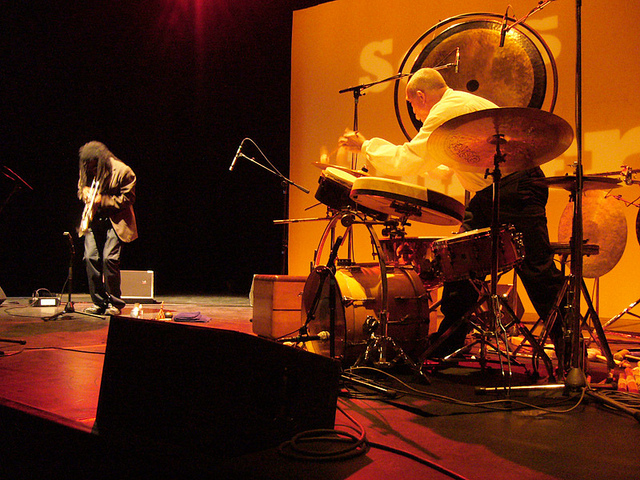 |
| Wadada Leo Smith, Gunther 'Baby' Soemmer, Vitry-Sur-Seine, Feb. 2011 |
The third chapter of the book is focused on 'improvisation as proficency', in which composition and performance can 'converge through time' until 'composing in real time'; gaining fluency - a feature of every language - requires time, efforts, and soaking up knowledges. It would be really interesting - that's what I did with some 'contemporary' musicians, but mostly in fits and starts - to discuss the five requirements attributed by Sparti to improvising - indivisibility, originality, irreversibility, responsiveness - and the differences he recognizes between improvisation and conversation - for Sparti, in jazz you always have to say something 'new', while in conversations if you don't use common expressions, you are at risk of being not understood; not every musician I told about the subject seems to be necessarily 'pro' - but even not necessarily 'contrary'.
 |
| Charles Gayle, Novara, June 2011 |
Trumpeter Wadada Leo Smith told me, as an example, that 'no one is experimenting today with new ways of expression', sounding as 'no one has this courage now', while at the opposite Peter Broetzmann told me 'I don't believe in new forms in arts'. But Broetzmann is both a musician and a painter, and I can recognize at least in some of his projects a direct confluence of both - as an example in Die Like a Dog, even if, when asked, he told me 'maybe'; another example of this convergence can be trumpeter and painter Bill Dixon - while at the opposite, bassist Christian Weber wrote me 'it would disturb me to work with the ambition to create something new everytime i play (since it is a fixed structure it's somehow limited and can become a formula too). But i feel the necessity of inventing anything a play in the moment it appears'.
This last statement goes on the same direction of Davide Sparti statements, since his idea of 'jazz habitus' - a Latin word used also by anthropologist Marcel Mauss for a knowledge coming directly from the body - involves a convergence of body and mind through a training whose progress is oriented by discontinuous changes that it would be impossible to measure on every performance. Not that far from what Viram Jasani was referring to Derek Bailey about the way an Indian musician learns to play a raga from his master, or from what Johann David Heinichen wrote about baroque music in his Der General Bass in der Komposition (1711).
 |
| Mary Halvorsom, London, Nov. 2011 |
What I would love to underline in discussing Sparti's Suoni Inauditi here is that his perspective on jazz as a tool for the develpment of the personality and identity of the musicians themselves is part of a bigger picture most of the musicians quite often show to be aware of, even using a different language, as Anthony Braxton in his Tri-Axium Writings, in which music is part of a wider knowledge about man, and his cultural tools as a way to relate to reality and to itself.
As in chapter four, dedicated to interactivity, what really musicians 'give and take' the one to and from the other is an open possibility to express themselves out of the gained patterns of (technical) behaviour, in a way that can also be developed outside of the music field, at least potentially.
In this sense it is fully comprehensible why a percussionist as Milford Graves - see William Parker interview with him on his book Conversations issued last year for Rogue Art - relates the art of percussions to some personal research through the field of 'alternative' medical sciences, as well as some statements by altoist Steve Lacy on staying 'on the border' as part of the creative process.

In 2010 L'Identità incompiuta. Paradossi dell'Improvvisazione Musicale (tr.: 'The Unfinished Identity. Paradoxes of Improvisation in Music'), Davide Sparti goes even further in reading improvisation and its relationships between music and identity, using as references mostly Hannah Arendt theory of human action and Michel Foucault technologies of the self.
For those readers not completely at ease with those categories, I'd like at firt to invite them to listen to double bassist and composer Stefano Scodanibbio Il Cielo sulla Terra, a piece of contemporary music whose libretto was composed by Giorgio Agamben, a disciple of both Martin Heidegger and Michel Foucault, as related to similar issues, an effort to give a comprehensive look on the development of avant garde music as an attempt to give men useful tools to regain their comprehension of life and themselves in their entirety against the oppression of an alienated, as in contemporary Western societies, life.
In The Human Condition, Hannah Arendt discuss about action and its effects over recognizement, as a production of a potential 'new identity'. Under this focus, the attempts of many jazz players trying not to reproduce themselves and to avoid repetition as an esthetic trap is at one corner, while the other extreme is loosing their own identities - and as consequence, the opportunity to play and to be heard, this is the 'paradox' of the title. If this is particularly true for the 'avant garde' movements of the past - AACM, Sun Ra Arkestra, Eric Dolphy - this frame is used to explain also the attitude of a musician like Sonny Rollins even today.
On the other hand, Foucault's 'technologies of the self' are in Sparti's view an attempt to preserve the musician through his journey from the desertion of the common shores of a certain solidified style of music to his new developing style and his new possible social and economical recognizement, avoiding isolation and misconstruction.
 |
| Guro Skumsens Moe, London, Oct. 2011 |
Since this last book involves such concepts as tranformation, authenticity, experience, in a way that can reconnect on one hand Sparti's studies to a wider broad of the last century philosophy developments, the ones related to reflections on identity opened after the end of World War II and leading Michel Foucault to his studies on the history of knowledge and sexuality, and their relationships with culture and power, and on the other hand the studies of phenomenological perception through Husserl and Merleau-Ponty at the limits of the self perception in Western Culture since Cartesian's Cogito and the developments of Western science as separated from the arts and other human knowledge fields, I'd love to start a new discussion more over in time, after some reflexions and studies on the subjects.
For the moment, I'd limit myself to consider that Sparti's references on Foucault are the ones that pushed me at a certain time to develop a knowledge of non-Western cultures, and their relationships with creativity. For those who would like to put an eye on Wadada Leo Smith's writings on music - but is the same with Anthony Braxton writings on the Tri-Centric Vibrational Dynamics - it will be clear that, far from being only tools to develop music, they are part of an attempt to re-connect, as Smith himself told me, 'the head and the heart' or, as Braxton would possibly put it, to restore a continuum in which human knowledges can be connected in a more, organic way through their own 'upper and lower partials'. A good starting point for the curious reader can be the last part of Graham Lock book on Braxton music, Forces in Motion. The Music And Thoughts of Anthony Braxton (see an extract here).
Related bibliography:
Davide Sparti, L'identità incompiuta. Paradossi nell’improvvisazione musicale, Bologna, Il Mulino, 2010
Further Readings:
Leo Smith, Notes (8 pieces) source a new world music: Creative Music, self published, 1973
Graham Lock, Forces In Motion: The Music and Thoughts of Anthony Braxton, DaCapo Press, 1989
Derek Bailey, Improvisation, Its Nature and Practice in Music, DaCapo Press, 1993
Davide Sparti, Il corpo sonoro. Oralità e scrittura nel jazz, Bologna, Il Mulino, 2007


